In much of the modern West, a funeral is a single event: the body is buried or cremated, and that is the end of it. In many other societies, past and present, death takes longer. The body is first placed somewhere temporary, and only after the flesh has gone are the bones gathered, cleaned and laid in their final resting place, often with a second, larger ceremony.
Anthropologists call this secondary burial. It is not a curiosity of a few remote places. It appears in ancient Jerusalem, in villages of modern Greece, in the highlands of Madagascar and in many parts of Southeast Asia, and it led one young French sociologist to a lasting insight about what death means to the living.
At a glance
- What: a first, temporary burial, followed after months or years by a second, final treatment of the bones.
- Theory: Robert Hertz (1907) argued that in such societies death is a process, and the second ceremony ends it for both the dead and the mourners.
- Madagascar: in famadihana, families open the tomb, rewrap the remains of ancestors in new cloth and celebrate with them.
- Greece: exhumation after several years and transfer of the bones to an ossuary is still practised in many places.
Robert Hertz and the time of death
In 1907 the French sociologist Robert Hertz, a student of Émile Durkheim, published a long essay on what he called the collective representation of death. Working mainly from accounts of the Dayak peoples of Borneo, he noticed a pattern: the body was kept or buried temporarily, a period of mourning followed, and a great final ceremony took place when only the bones remained. For Hertz the three things belonged together. While the body decomposed, the soul was believed to be in an uncertain state between worlds, and the mourners too lived apart, under restrictions. The second funeral ended all three transitions at once.
Hertz was killed in the First World War in 1915. His essay, translated into English in 1960 as part of Death and the Right Hand, remains one of the founding texts of the anthropology of death.
Ancient Jerusalem: bones in stone chests
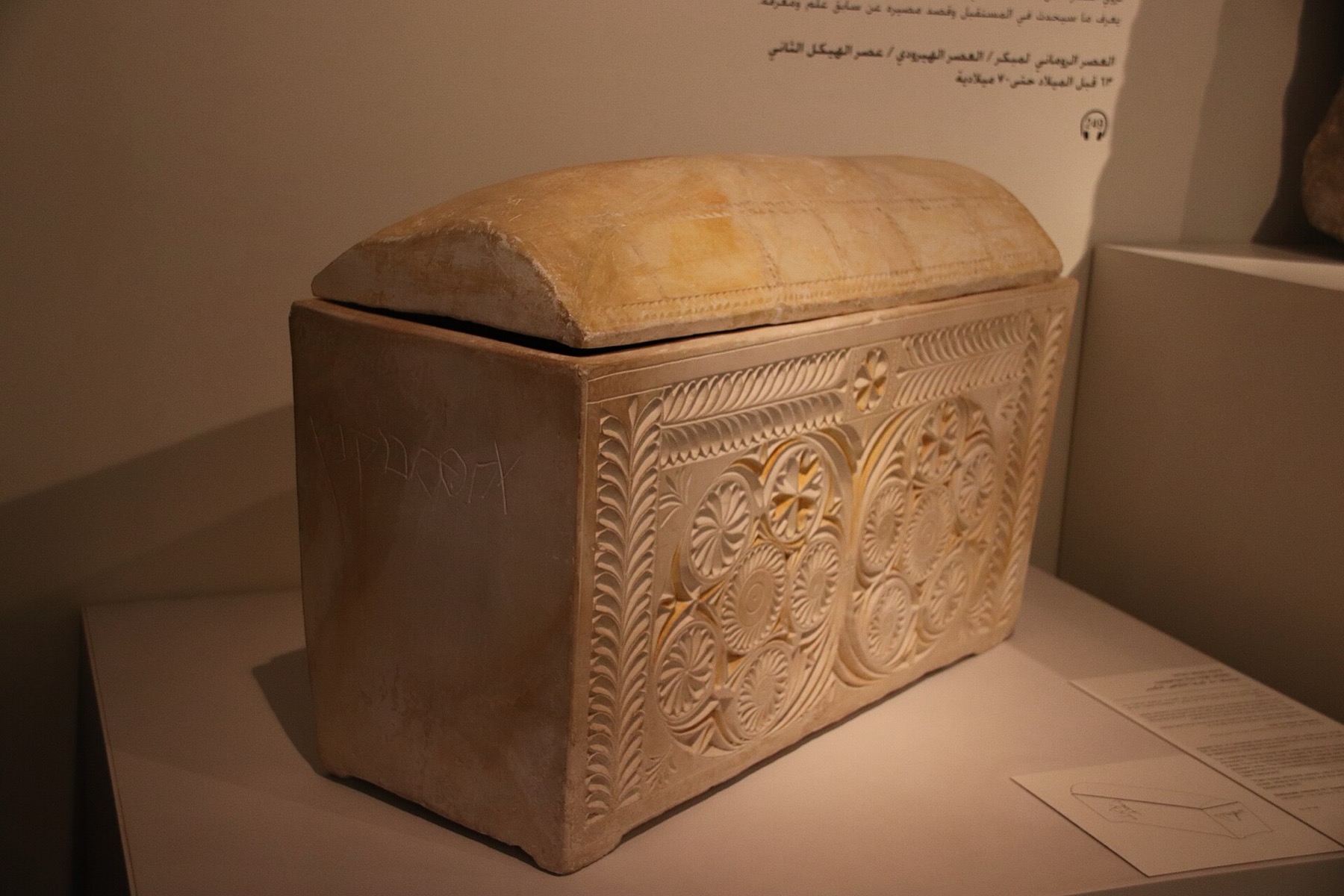
Between roughly the late first century BC and the late first century AD, many Jewish families in and around Jerusalem buried their dead in rock-cut family tombs and later gathered the bones into small limestone chests, ossuaries, often carved with rosettes and sometimes inscribed with a name. Thousands have been found. In 1990, construction work in the North Talpiyot area of Jerusalem exposed a burial cave with a group of ossuaries; one of them, now in the Israel Museum and shown above, is inscribed “Joseph son of Caiaphas”. The inscriptions from this cave are published in the scholarly corpus of Jerusalem inscriptions.
Rural Greece
The anthropologist Loring Danforth described the same logic in a village in northern Greece in the 1970s. Several years after burial, the grave is opened, the bones are exhumed, washed and placed in a box in the village ossuary. The exhumation is an emotional moment: the state of the bones is watched closely, and the event marks the end of the long period of mourning, especially for the women of the family who have tended the grave.
Madagascar: famadihana
In the central highlands of Madagascar, families hold famadihana, often translated as “the turning of the bones”. The family tomb is opened, the remains of ancestors are taken out, wrapped in new cloth, carried and danced with, and then returned to the tomb. The anthropologist Maurice Bloch’s study of the Merina showed how central the ancestral tomb is to kinship and identity. The historian Pier M. Larson has shown that famadihana is not a timeless survival: it is an Austronesian custom of secondary burial that changed significantly over the course of highland history.
Documented / Disputed
Documented
- Hertz (1907) linked the decomposition of the body, the state of the soul and the period of mourning, ended by a second ceremony (Hertz, English translation 1960).
- Jewish families in Second Temple Jerusalem placed bones in limestone ossuaries; the ossuary of “Joseph son of Caiaphas” was found in North Talpiyot in 1990 (CIIP, “Caiaphas Cave”).
- In rural Greece, exhumation after several years and transfer to an ossuary ends formal mourning (Danforth).
- Famadihana is a form of secondary burial whose practice changed over time (Larson; Bloch).
Disputed or often repeated
- “Famadihana is an unchanged ancient ritual.” Larson shows that it was transformed over time.
- Whether the Caiaphas ossuary belonged to the high priest of the Gospels. Many scholars accept it; others point out that the inscription does not call him high priest.
- “Second burial shows disrespect for the dead.” The opposite: in these cultures it is the final act of care.
Timeline
- Late 1st century BC – late 1st century AD: Ossuary burial is common among Jewish families in Jerusalem.
- 1907: Robert Hertz publishes his essay on the collective representation of death.
- 1915: Hertz is killed in the First World War.
- 1960: Hertz’s essay appears in English in Death and the Right Hand.
- 1971: Maurice Bloch publishes Placing the Dead on Merina tombs and kinship.
- 1982: Loring Danforth publishes The Death Rituals of Rural Greece.
- 1990: The burial cave with the “Joseph son of Caiaphas” ossuary is found in North Talpiyot.
- 2001: Pier M. Larson publishes his history of famadihana.
Sources
Primary sources
- “Caiaphas Cave”, in Corpus Inscriptionum Iudaeae/Palaestinae, vol. 1: Jerusalem (De Gruyter, 2010): 481–490. doi:10.1515/9783110222203.481.
Secondary sources
- Robert Hertz, Death and The Right Hand, trans. Rodney and Claudia Needham (Cohen and West, 1960). Internet Archive.
- Loring M. Danforth, The Death Rituals of Rural Greece, photographs by Alexander Tsiaras (Princeton University Press, 1982). doi:10.1515/9780691218199.
- Pier M. Larson, “Austronesian Mortuary Ritual in History: Transformations of Secondary Burial (Famadihana) in Highland Madagascar”, Ethnohistory 48, nos. 1–2 (2001): 123–155. doi:10.1215/00141801-48-1-2-123.
- Maurice Bloch, Placing the Dead: Tombs, Ancestral Villages, and Kinship Organization in Madagascar (Seminar Press, 1971).
Image credits
- Header image: Ossuary inscribed “Joseph son of Caiaphas”, Israel Museum: Gary Todd, 2018. Israel Museum, Jerusalem. Licence: CC0 1.0 (public domain), via Wikimedia Commons.
Related
- Charnel Houses and Ossuaries: Where Europe Kept Its Bones
- Sky Burial: Giving the Dead to the Birds in Tibet
- Case page: The Paris Catacombs, 1785–1860
Part of Death Customs in Dark History, Documented. How we research and how we use AI: Editorial Standards. Spotted an error? Tell us at contact@macabrechronicle.com; fixes are logged on the Corrections page.
Editor’s note: This article replaces a shorter piece on second burials that first appeared in the Macabre Chronicle section of moleopedia.com. It was rewritten from the sources above and published here on 30 October 2026.
Halloween Picks

MGparty 14.5 ft Halloween Inflatable Walk-In Pumpkin House with LED Lights

Spirit Halloween 54-Inch Sitting Scarecrow Animatronic

Kalolary 12ft Halloween Witch Haunted House Inflatable Archway
As an affiliate, we earn on qualifying purchases.