Content note: This article and its images show human bones displayed in ossuaries that are open to the public.
For centuries, being buried in a churchyard did not mean staying there. In many parts of Europe a grave was reused after some years, and the bones that came up were moved into a charnel house or ossuary: a chapel, crypt or underground gallery where they were stacked, ordered and sometimes decorated.
Today some of these places are famous: the Paris Catacombs, the bone chapel at Sedlec near Kutná Hora, the painted skulls of Hallstatt. Their histories are less macabre than the internet suggests, and many of the numbers attached to them are estimates that nobody can check.
At a glance
- What: buildings or underground spaces for bones taken from reused graves.
- Why: crowded churchyards, and in the Middle Ages a religious duty to keep the remains of the dead together on consecrated ground.
- Paris: the city’s cemeteries were emptied into old quarries from 1785 to 1860; the ossuary opened to visitors in 1809.
- Counts: figures such as “six million” in Paris or “40,000” at Sedlec are estimates; the sites’ own guides do not give exact numbers.
Medieval charnel chapels
In medieval England, digging a new grave in a busy churchyard regularly brought up older bones. Many parishes built charnel chapels, often a vaulted room under a chapel, to keep them. Archaeologists Elizabeth Craig-Atkins, Jennifer Crangle and Paul Barnwell, who studied these buildings, argue that they were more than storerooms: they were places where the living could see the bones of the dead and pray for them, closely tied to medieval belief in the resurrection of the body. Most English charnel houses were cleared after the Reformation; the medieval collections at Rothwell in Northamptonshire and Hythe in Kent are rare survivors.
Paris: from the Innocents to the Catacombs
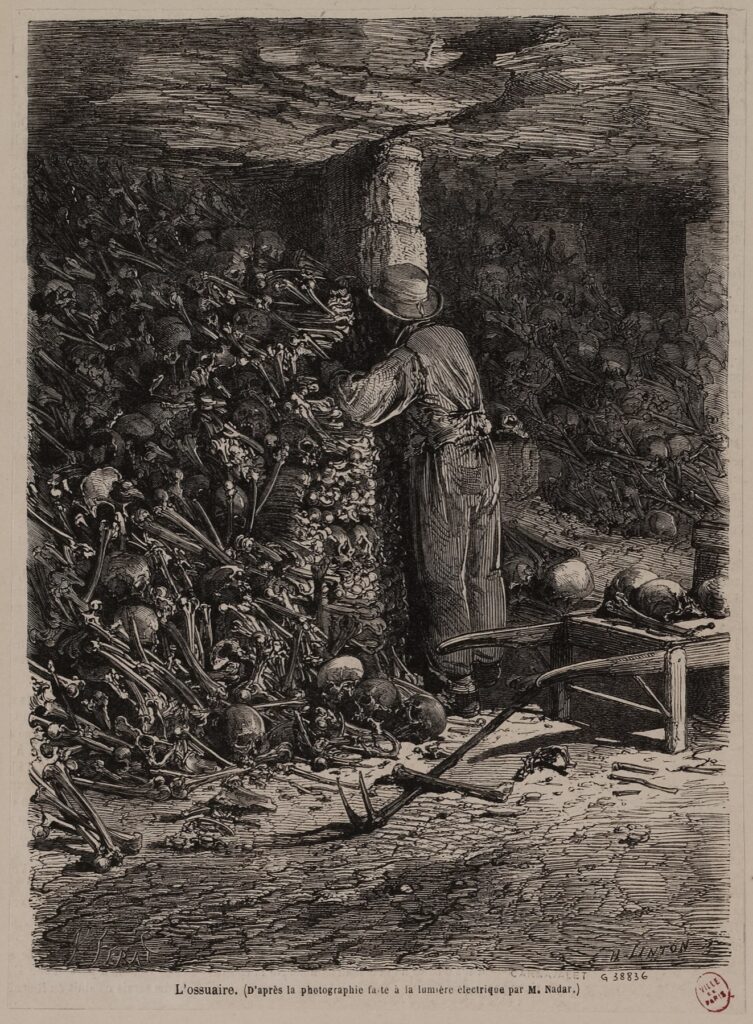
The Cemetery of the Holy Innocents in the centre of Paris had been in use for nearly ten centuries when it was closed in 1780. According to the official history of the Catacombs, the authorities chose former limestone quarries at Tombe-Issoire, then outside the city, as a new resting place. The first transfers of bones ran from 1785 to 1787, and the site was consecrated as the Paris Municipal Ossuary on 7 April 1786. Other parish cemeteries followed until 1814, transfers resumed in 1840, and the last deposits came during Baron Haussmann’s rebuilding of the city in 1859–1860.
Between 1810 and 1814 the quarry inspector Louis-Étienne Héricart de Thury had the bones rearranged into the walls of skulls and long bones that visitors see today. The ossuary had already opened to visitors by appointment in 1809. The present visit runs for 1.5 kilometres, about 20 metres below the street.
Sedlec, Kutná Hora
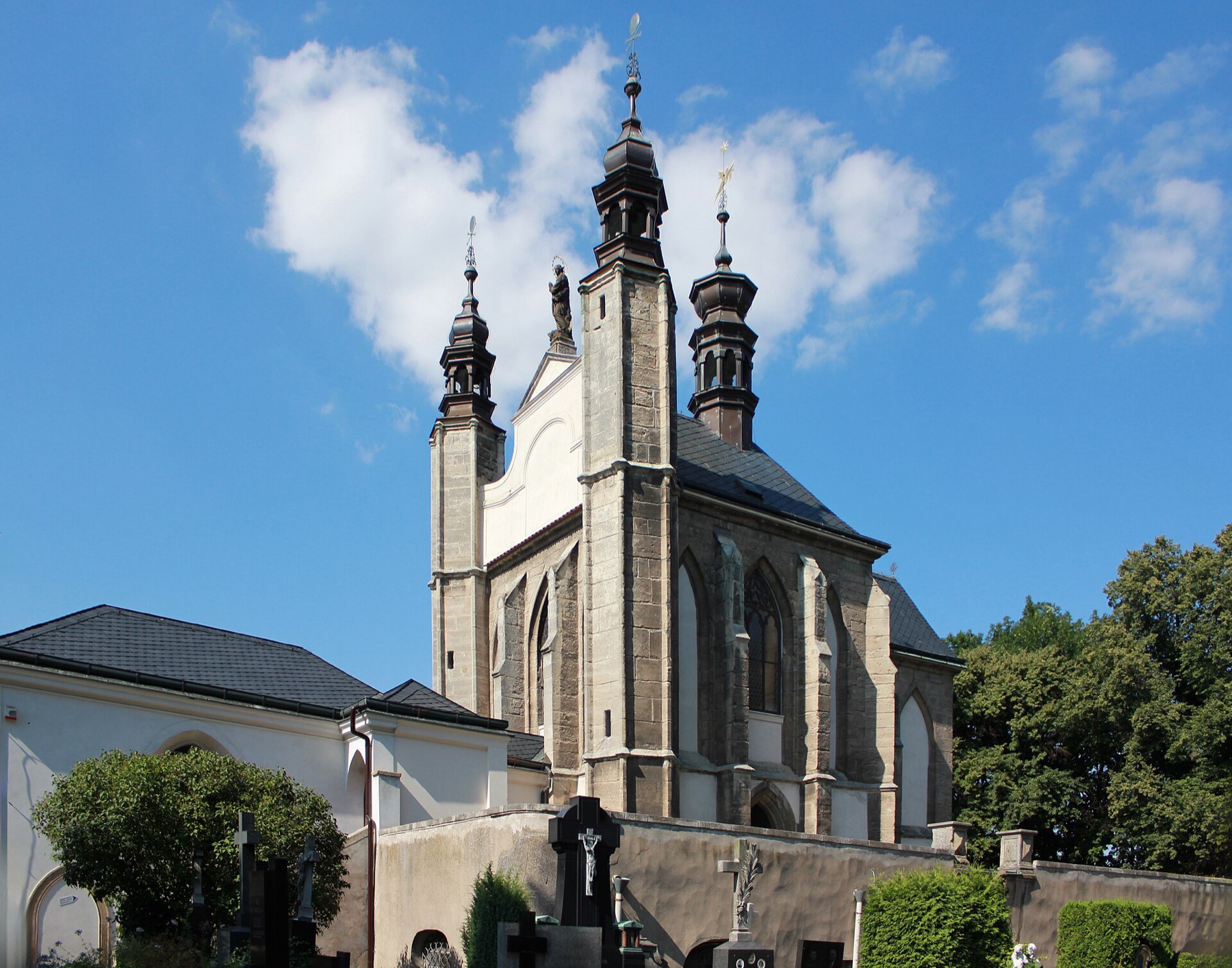
The ossuary at Sedlec lies under the Cemetery Church of All Saints, a two-storey Gothic church built in the first half of the 14th century on the grounds of a Cistercian monastery. The site’s own guide calls it a resting place for “thousands of people” and admits that “we know almost nothing about the people who are now buried in the ossuary”. The famous decorations, including a chandelier said to use every bone of the human body and four great pyramids of bones, are hard to date. The Schwarzenberg coat of arms made of bones is the work of the woodcarver František Rint, around 1870, as thanks to the noble family that had saved the ossuary.
Hallstatt’s painted skulls
In the Austrian salt-mining village of Hallstatt, the bone house sits in St Michael’s Chapel beside the parish church. When a grave was reused, the skull and some bones were moved there. According to the village’s own site, a survey in 1948–1950 documented 2,104 skulls, more than 600 of them painted: wreaths, flowers, a black cross on the forehead, often a name or initials. Most were painted in the late 18th and 19th centuries, and a few in the 20th. The skulls are only a small fraction of the village’s dead; the parish death register alone has about 30,000 entries before 1900.
Documented / Disputed
Documented
- Paris: Holy Innocents closed in 1780; transfers 1785–1787, then to 1814, resumed 1840, last deposits 1860; consecrated 7 April 1786; visits from 1809 (official Catacombs site).
- Sedlec: the church dates from the first half of the 14th century; the Schwarzenberg arms are by František Rint, around 1870 (official Sedlec site).
- Hallstatt: 2,104 skulls documented in 1948–1950, more than 600 painted (hallstatt.net).
- Medieval English charnel houses were devotional spaces as well as stores for bones (Craig-Atkins, Crangle and Barnwell).
Disputed or often repeated
- “Six million people in the Paris Catacombs.” A widely quoted estimate. The official history pages do not give a figure, and no count exists.
- “40,000 to 70,000 skeletons at Sedlec.” Often repeated; the site’s own guide says only “thousands”.
- “A half-blind monk stacked the Sedlec bones in 1511.” A popular story; the site’s guide says it is hard to tell who made the decorations, when or why.
- “Ossuaries were built only for lack of space.” Space mattered, but medieval charnel houses also had a religious purpose, and in Hallstatt the skulls are too few to explain the practice by space alone.
Timeline
- Medieval period: Charnel chapels are built in English parishes and across Europe.
- First half of the 14th century: The Cemetery Church of All Saints is built at Sedlec.
- 1780: The Cemetery of the Holy Innocents in Paris is closed.
- 1785–1787: First transfers of bones into the Tombe-Issoire quarries.
- 7 April 1786: Consecration of the Paris Municipal Ossuary.
- 1809: The Paris ossuary opens to visitors by appointment.
- 1810–1814: Héricart de Thury rearranges the Paris ossuary.
- 1859–1860: Last transfers of bones to the Catacombs during Haussmann’s works.
- About 1870: František Rint creates the Schwarzenberg coat of arms at Sedlec.
- 1948–1950: Survey of the Hallstatt bone house documents 2,104 skulls.
Sources
Primary sources
- Catacombes de Paris (Paris Musées), “Site history” and “The ossuary”. catacombes.paris.fr.
- Sedlec Ossuary, official site, “Ossuary”. sedlec.info.
- Hallstatt tourism, “Bone house of Hallstatt”. hallstatt.net.
Secondary sources
- Elizabeth Craig-Atkins, Jennifer Crangle and Paul Barnwell, “Charnel practices in medieval England: new perspectives”, Mortality 24 (2019): 145–166. doi:10.1080/13576275.2019.1585782.
- Paul Barnwell, Elizabeth Craig-Atkins and Jennifer Crangle, “Medieval Charnel Houses: Resurrecting Lost Medieval Rites”, Journal of the British Archaeological Association 176 (2023): 270–295. doi:10.1080/00681288.2023.2205264.
Image credits
- Header image: Sedlec Ossuary, Kutná Hora: Perituss, 2010. Licence: CC0 1.0 (public domain), via Wikimedia Commons.
- Header image: “L’ossuaire. Catacombes de Paris”, historic photograph: Unknown photographer, Musée Carnavalet – Histoire de Paris (Paris Musées). Licence: CC0 1.0 (public domain), via Wikimedia Commons.
Related
- Case page: The Paris Catacombs, 1785–1860
- Case page: Sedlec Ossuary, Kutná Hora
- Second Burials: When Funerals Happen Twice
Part of Death Customs in Dark History, Documented. How we research and how we use AI: Editorial Standards. Spotted an error? Tell us at contact@macabrechronicle.com; fixes are logged on the Corrections page.
Editor’s note: This article replaces three shorter pieces on charnel houses and ossuaries that first appeared in the Macabre Chronicle section of moleopedia.com. It was rewritten from the sources above and published here on 30 October 2026.
Halloween Picks

Halloween Inflatable Haunted House Maze – 20×20 ft with Removable Roof and Blower

Kalolary 12ft Halloween Witch Haunted House Inflatable Archway

MGparty 14.5 ft Halloween Inflatable Walk-In Pumpkin House with LED Lights
As an affiliate, we earn on qualifying purchases.