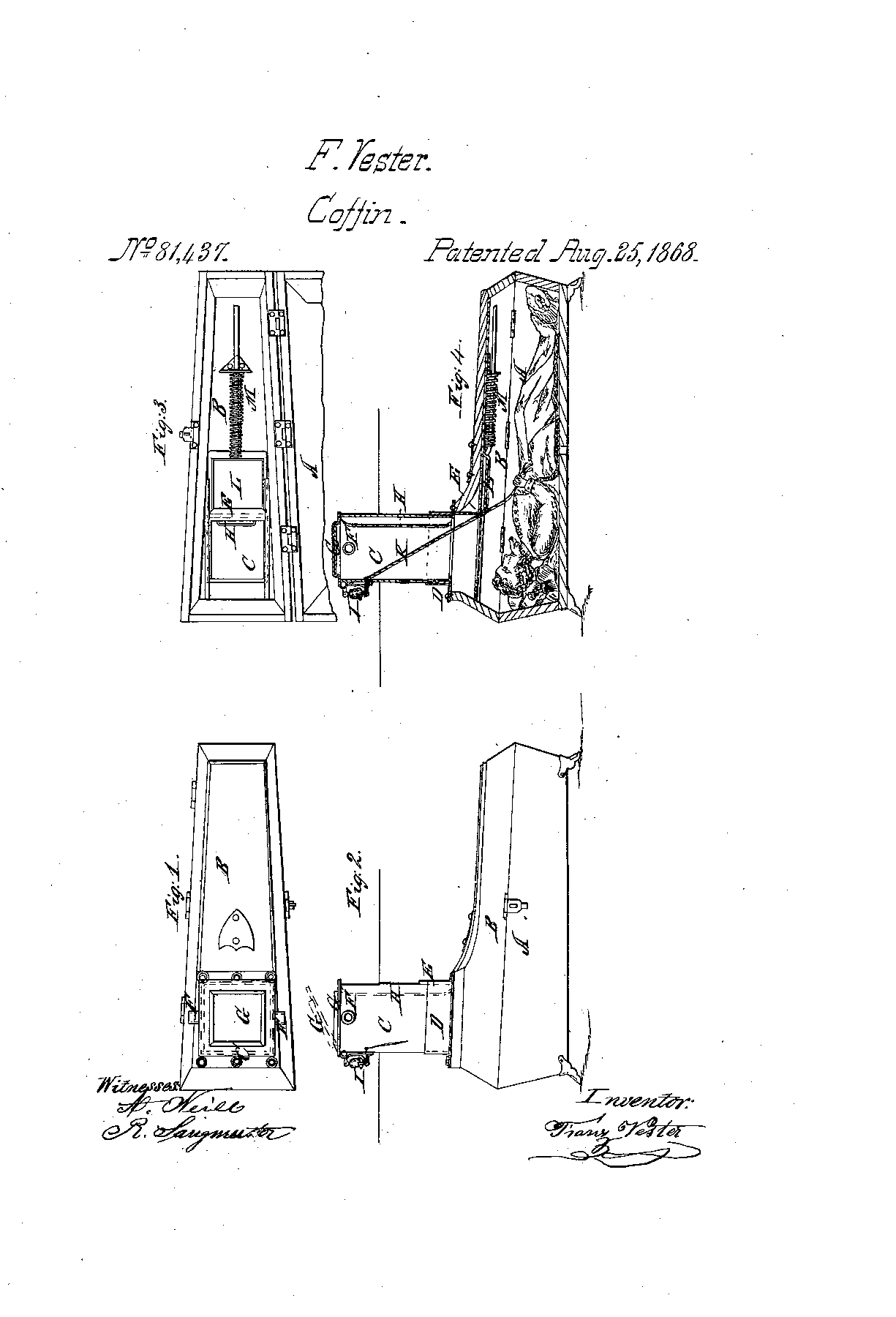

In August 1868 the United States Patent Office granted patent number 81,437 to Franz Vester of Newark, New Jersey, for an “Improved Burial-Case”. Over the coffin lid, directly above the face, stood a square tube that reached up through the soil. Inside it were a ladder and a cord. One end of the cord was placed in the dead person’s hand, the other was tied to a bell at the top, so that anyone buried “ere life is extinct” could climb out or ring for help.
Vester’s coffin was one of dozens of such designs. For about a century, doctors, inventors and anxious citizens in Europe and North America worked on the same problem: how to make sure that nobody was buried alive. Their inventions are well documented. Evidence that any of them ever saved a life is not.
At a glance
- When: roughly the 1790s to the early 1900s, with most designs in Germany, Britain, France and the United States.
- How they worked: air tubes, viewing windows, flags, and bells connected by cords to the hands of the dead.
- Why: 18th-century physicians had argued that the usual signs of death were unreliable.
- Rescues: the historian Jan Bondeson found no documented case of anyone saved by a safety coffin.
Where the fear came from
The safety coffin was an answer to a medical argument. In 1740 the Danish-born anatomist Jacques-Bénigne Winslow defended a thesis in Paris on the uncertainty of the signs of death, and two years later the French physician Jean-Jacques Bruhier published an expanded French version packed with stories of people who had supposedly woken up in their coffins. The book was translated and copied across Europe. Its anecdotes were rarely checked, but its message stuck: doctors could not always tell death from a deep faint, a trance or a coma.
By the 19th century the fear had a name in German, Scheintod (apparent death), and a literature of its own. Edgar Allan Poe’s story “The Premature Burial” (1844) fed it, and in 1896 the campaigners William Tebb and Edward Perry Vollum published Premature Burial and How It May Be Prevented, a long collection of cases and proposals. Not every doctor agreed: in 1897 the physician David Walsh answered with a short book whose title asked the obvious question, Premature Burial: Fact or Fiction?
The designs
The earliest safety coffins were simple. According to Bondeson, Duke Ferdinand of Brunswick, who died in 1792, had a coffin made with a window and an air hole, and a lid that could be opened from inside. In 1829 the German physician Johann Gottfried Taberger published a design in which cords ran from the hands, feet and head of the body to a bell above the grave.
American inventors took up the idea in the second half of the century. Vester’s 1868 patent adds a ladder, a glass inspection door and a sliding shutter that closed the coffin when the tube was pulled out again: the patent explains that, if life was found to be extinct on inspection, the tube could be withdrawn and used for another burial. In the 1890s, according to Bondeson, the Russian chamberlain Count Michel de Karnice-Karnicki promoted a device in which the slightest movement of the chest released a spring, opened an air box, raised a flag and rang a bell.
Most of these designs share the same weakness. A body changes after death: it swells, shifts and settles, which could pull a cord or tip a ball. A bell that rang in the night was more likely to signal decomposition than revival.
Did anyone ring the bell?
The physician and historian Jan Bondeson, who went through the case collections of the 18th and 19th centuries for his book Buried Alive, concluded that he could find no reliable record of anyone being rescued by a safety coffin. Many of the dramatic cases in older books came from newspapers that copied one another, gave no names or dates, or could not be traced to any parish or court record.
That does not mean the fear was baseless. Before modern medicine, misdiagnosed death did happen in individual cases, and the campaign led to practical changes: longer waiting periods before burial, waiting mortuaries in German cities where bodies were watched until decay was certain, and better training in the signs of death. The safety coffin itself remained a product for the anxious few.
Saved by the bell? Not from a grave
Internet lists like to claim that “saved by the bell”, “dead ringer” and “graveyard shift” come from safety coffins. They do not. “Saved by the bell” comes from boxing, where the bell ending a round could save a fighter from being counted out. “Dead ringer” comes from horse racing slang for an illegal look-alike substitute, and “graveyard shift” refers to night work. The coffin explanations circulate in the well-known chain text “Life in the 1500s”, which reference sites have long since checked and rejected.
Documented / Disputed
Documented
- Winslow (1740) and Bruhier (1742) argued that the common signs of death were uncertain; their work spread the fear of premature burial (Alexander; Bondeson).
- Safety coffins with air tubes, windows, cords and bells were designed and patented, for example Vester’s U.S. Patent 81,437 of 1868 (patent text).
- Campaigners such as Tebb and Vollum (1896) collected cases and demanded reforms; other physicians such as Walsh (1897) disputed how common premature burial really was.
Disputed or often repeated
- Rescues by safety coffin. Bondeson found no documented case. Stories of bells ringing in cemeteries are anecdotes without names, dates or records.
- How common premature burial was. Campaigners counted hundreds of cases, but most came from unverified press reports. Historians treat the numbers as unreliable.
- “Saved by the bell”, “dead ringer”, “graveyard shift”. Not from safety coffins; the phrases come from boxing, horse racing and night work (Phrase Finder; Snopes).
- Duke Ferdinand of Brunswick’s coffin (1792). Reported by Bondeson from older accounts; we have not seen a primary record.
Timeline
- 1740: Jacques-Bénigne Winslow defends his thesis on the uncertainty of the signs of death in Paris.
- 1742: Jean-Jacques Bruhier publishes an expanded French version with many anecdotal cases.
- 1792: Duke Ferdinand of Brunswick dies; he is reported to have had a safety coffin made.
- 1829: Johann Gottfried Taberger publishes a bell-and-cord design in Germany.
- 1844: Edgar Allan Poe publishes “The Premature Burial”.
- 1868: Franz Vester of Newark receives U.S. Patent 81,437 for his “Improved Burial-Case”.
- 1890s: Count Michel de Karnice-Karnicki promotes his chest-movement alarm coffin.
- 1896–1897: Tebb and Vollum publish Premature Burial and How It May Be Prevented; David Walsh replies with Premature Burial: Fact or Fiction?
Sources
Primary sources
- Franz Vester, “Improved Burial-Case”, U.S. Patent 81,437, 25 August 1868. Google Patents.
- William Tebb and Edward Perry Vollum, Premature Burial and How It May Be Prevented (London: Swan Sonnenschein, 1896). Internet Archive.
- David Walsh, Premature Burial: Fact or Fiction? (London: Baillière, Tindall and Cox, 1897). Internet Archive.
- Edgar Allan Poe, “The Premature Burial” (1844), in The Works of Edgar Allan Poe, vol. 2. Project Gutenberg.
Secondary sources
- Jan Bondeson, Buried Alive: The Terrifying History of Our Most Primal Fear (W. W. Norton, 2001). Publisher’s page.
- Marc Alexander, “‘The Rigid Embrace of the Narrow House’: Premature Burial and the Signs of Death”, The Hastings Center Report 10, no. 3 (1980): 25. doi:10.2307/3560926.
- “Saved by the bell”, The Phrase Finder. phrases.org.uk.
- “Life in the 1500s”, Snopes. snopes.com.
Image credits
- Header image: Franz Vester, drawing for U.S. Patent 81,437, “Improved Burial-Case”: Franz Vester, patented 25 August 1868. U.S. Patent and Trademark Office record via Google Patents. Licence: Public domain (published 1868), via Google Patents.
Related
- Buried Alive: How a Medical Debate Became a Panic
- Wakes and Vigils: Why the Living Sat Up With the Dead
Part of Death Customs in Dark History, Documented. How we research and how we use AI: Editorial Standards. Spotted an error? Tell us at contact@macabrechronicle.com; fixes are logged on the Corrections page.
Editor’s note: This article replaces three shorter pieces on coffin bells and safety coffins that first appeared in the Macabre Chronicle section of moleopedia.com. It was rewritten from the sources above and published here on 30 October 2026.
Halloween Picks

Kalolary 11 ft Halloween Inflatable Archway Ghost House Tunnel

10 ft Halloween Inflatable Archway with Built-in LEDs

Haunted Hill Farm 2-Ft. Zombie Raccoon Halloween Animatronic
As an affiliate, we earn on qualifying purchases.