
On the night of 14 December 1799, a few hours before he died, George Washington gave his secretary Tobias Lear one last instruction: “Have me decently buried; and do not let my body be put into the vault in less than three days after I am dead.” Lear wrote it down. The first president of the United States was not unusual. Educated people across Europe and America shared the same fear: that a doctor might mistake a deep faint for death, and that they would wake up underground.
The fear had a history. It began as a medical argument about how to recognise death, grew into a public campaign with books, societies and special buildings, and faded when doctors and the law found better answers. This article follows the record; the inventions it produced have their own article on safety coffins and burial bells.
At a glance
- Origin: a 1740 thesis by Jacques-Bénigne Winslow and its 1742 French expansion by Jean-Jacques Bruhier argued that the usual signs of death were unreliable.
- Response: “waiting mortuaries”, the first in Weimar in 1792, where bodies were watched until decay was certain.
- Peak: the 1890s, when campaigners in Britain published collections of cases and lobbied for reform.
- Evidence: few cases survive scrutiny; Jan Bondeson found that the waiting mortuaries never recorded a revival.
A doubt in the medical books
For most of history, death was recognised by the obvious signs: no breath, no pulse, a cold body. In 1740 the anatomist Jacques-Bénigne Winslow, working in Paris, defended a thesis arguing that these signs could deceive and that only the beginning of decay was certain. Two years later the physician Jean-Jacques Bruhier published a French version expanded with dozens of stories of people who had supposedly revived in their shrouds or coffins.
The anecdotes were mostly second-hand and rarely checked, but the book was widely read and copied. Over the next century the idea spread that “apparent death” (in German, Scheintod) was common, that cholera, catalepsy or a deep trance could imitate death, and that hasty burial was a real danger.
Waiting mortuaries
The most practical answer came from Germany. At the urging of the physician Christoph Wilhelm Hufeland, Weimar opened a Leichenhaus, a waiting mortuary, in 1792. Its gable carried the words Vitae dubiae asylum, “a refuge for doubtful life”; a model of the building is kept today at the Museum für Sepulkralkultur in Kassel. Bodies were laid out in a heated hall, sometimes with cords tied to the fingers and connected to a bell, and attendants watched over them until the signs of decay left no doubt.
Other German cities followed in the 19th century. The waiting mortuaries were expensive and many families disliked them, and, as Bondeson notes, they never produced the revivals they were built for. By the end of the century physicians were recognising death reliably enough that the buildings lost their purpose.
The campaign of the 1890s
In Britain the fear returned in force at the end of the century. In 1896 William Tebb and Edward Perry Vollum published Premature Burial and How It May Be Prevented, a thick collection of cases from newspapers and medical writings, and the book was reissued in an enlarged edition in 1905 with the physician Walter Hadwen. Campaigners called for registered death certificates signed only after an examination, waiting periods before burial, and public mortuaries on the German model.
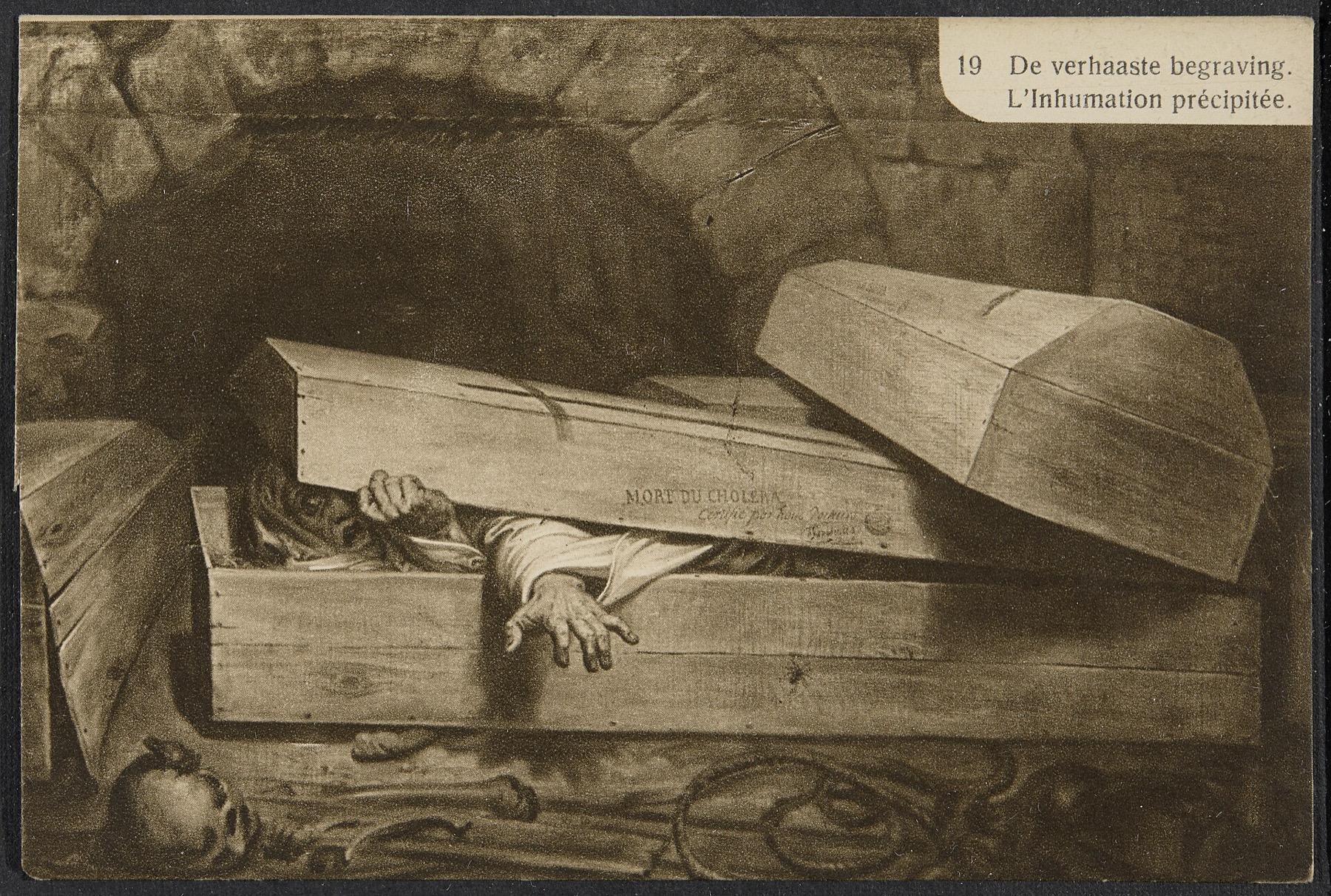
Not every doctor was persuaded. In 1897 the physician David Walsh answered with Premature Burial: Fact or Fiction?, arguing that most of the cases fell apart under examination. Edgar Allan Poe’s story “The Premature Burial” (1844) and Antoine Wiertz’s painting The Hasty Burial (1854) had already made the fear part of popular culture.
What the evidence says
The folklorist Eda Kalmre, who studied stories of apparent death from the 18th century onwards, describes how such reports travelled from one publication and one country to another, usually without anyone checking whether they were true. Historians who have checked the case collections, among them Jan Bondeson, found that only a handful of cases could be traced to identifiable people, and none to a rescue by a safety device.
Some popular “proof” has an ordinary explanation. Bodies change after death: gases build up, limbs shift, coffins collapse under the weight of soil. Exhumed remains that look disturbed are not evidence that the person woke up. What the panic did achieve was lasting: proper medical certification of death and legal waiting periods before burial.
Documented / Disputed
Documented
- Washington asked that his body not be placed in the vault for three days after his death (Lear’s account, Mount Vernon).
- Winslow (1740) and Bruhier (1742) argued that the common signs of death were uncertain (Alexander; Bondeson).
- Weimar opened a waiting mortuary in 1792 at Hufeland’s instigation (Museum für Sepulkralkultur; Kalmre).
- Tebb and Vollum (1896, enlarged 1905) campaigned against premature burial; Walsh (1897) disputed their cases (original texts).
Disputed or often repeated
- How often people were buried alive. Campaigners counted hundreds of cases; few survive checking. No reliable figure exists.
- Scratch marks inside coffins. Often told, rarely documented, and easily explained by post-mortem changes and damage.
- “Waiting mortuaries saved many lives.” Bondeson found no recorded revival in them.
- Famous people who feared it. Lists online mix documented requests, such as Washington’s, with anecdotes that have no source.
Timeline
- 1740: Winslow defends his thesis on the uncertainty of the signs of death in Paris.
- 1742: Bruhier publishes an expanded French version full of anecdotal cases.
- 1792: Weimar opens a waiting mortuary at Hufeland’s instigation.
- 14 December 1799: George Washington asks not to be placed in the vault for three days after his death.
- 1844: Edgar Allan Poe publishes “The Premature Burial”.
- 1854: Antoine Wiertz paints The Hasty Burial.
- 1896: Tebb and Vollum publish Premature Burial and How It May Be Prevented.
- 1897: David Walsh replies with Premature Burial: Fact or Fiction?
- 1905: An enlarged edition of Tebb and Vollum’s book appears with Walter Hadwen.
Sources
Primary sources
- Tobias Lear, account of George Washington’s death, December 1799. George Washington’s Mount Vernon.
- William Tebb and Edward Perry Vollum, Premature Burial and How It May Be Prevented (London: Swan Sonnenschein, 1896). Internet Archive; enlarged edition with Walter R. Hadwen (1905): Internet Archive.
- David Walsh, Premature Burial: Fact or Fiction? (London: Baillière, Tindall and Cox, 1897). Internet Archive.
- Model of the Weimar waiting mortuary (1792), Museum für Sepulkralkultur, Kassel. museum-digital.
Secondary sources
- Jan Bondeson, Buried Alive: The Terrifying History of Our Most Primal Fear (W. W. Norton, 2001). Publisher’s page.
- Eda Kalmre, “Buried Alive: The Phenomenon of Apparent Death in Estonian Tradition”, Folklore: Electronic Journal of Folklore 81 (2021): 101–120. doi:10.7592/FEJF2021.81.kalmre (PDF).
- Marc Alexander, “‘The Rigid Embrace of the Narrow House’: Premature Burial and the Signs of Death”, The Hastings Center Report 10, no. 3 (1980): 25. doi:10.2307/3560926.
Image credits
- Header image: Antoine Wiertz, L’Inhumation précipitée (The Hasty Burial), 1854; postcard reproduction: Antoine Wiertz (1806–1865), painted 1854. KU Leuven Libraries. Licence: Public domain, via Wikimedia Commons.
Related
- Safety Coffins and Burial Bells: The Inventions Against Being Buried Alive
- Wakes and Vigils: Why the Living Sat Up With the Dead
Part of Dark Medicine in Dark History, Documented. How we research and how we use AI: Editorial Standards. Spotted an error? Tell us at contact@macabrechronicle.com; fixes are logged on the Corrections page.
Editor’s note: This article replaces three shorter pieces on the fear of being buried alive that first appeared in the Macabre Chronicle section of moleopedia.com. It was rewritten from the sources above and published here on 30 October 2026.
Halloween Picks

Spirit Halloween 54-Inch Sitting Scarecrow Animatronic

Thuodo 8 FT Tall Halloween Inflatable Three-Headed Dragon with LEDs

Haunted Hill Farm 2-Ft. Zombie Raccoon Halloween Animatronic
As an affiliate, we earn on qualifying purchases.