Content note: This article describes how bodies are prepared for vultures. It contains no images of human remains.
On the Tibetan plateau, the dead have for centuries been carried at dawn to a site above the village, prepared, and offered to vultures. Outsiders call it “sky burial”. The Tibetologist Dan Martin points out that Tibetan has no phrase that corresponds to the English term: older Tibetan texts speak of carrying the dead “to the mountain” or of “scattering the body to the birds”.
Martin’s study of the practice, published in 1996, remains the most careful survey of the written evidence. It is also honest about how much is unknown, beginning with a simple question: when did sky burial begin?
At a glance
- Definition: “the deliberate, culturally countenanced, exposure of human corpses to carrion birds” (Martin).
- Where: Tibet, and in different forms among Zoroastrians in Iran and the Parsis of India.
- Earliest written account: an inaccurate report by the European traveller Friar Odoric in the 14th century; the oldest Tibetan description found by Martin dates from 1685.
- Origins: unknown. Martin considers contact with Zoroastrian culture “rather likely” but draws no definite conclusion.
What happens
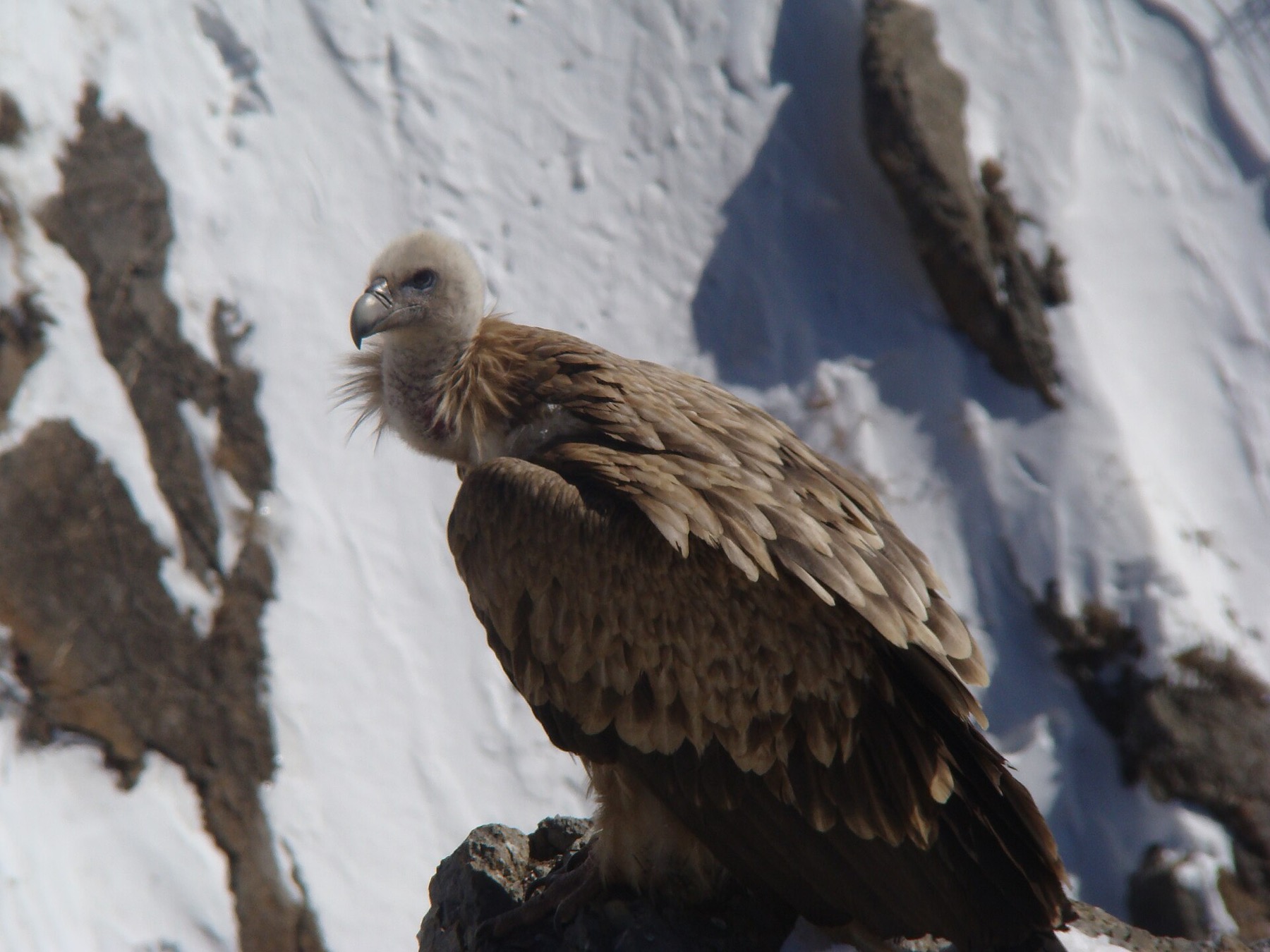
The rite takes the body to a site above the settlement, called simply a dur-khrod, a cemetery, in ordinary Tibetan speech. There it is prepared so that the birds can consume it. Martin quotes a decree of 1793 that describes remains being chopped up and mixed with barley flour as food for vultures or dogs, and he notes that for deaths from contagious disease, practitioners of the meditative tradition called Gcod were called on to perform the funeral rites. The birds that gather are mostly large griffon vultures, like the Himalayan griffon pictured above.
Outsiders have often described the rite with relish. We do not: it is a funeral, carried out by and for families, and this article contains no pictures of it.
Why sky burial?
Writers have long explained the practice through geography. Cremation needs a great deal of fuel, and on much of the plateau, Martin notes, wood was scarce, the most available trees made poor firewood, and good timber was needed for building and expensive to transport; dried dung was the usual fuel. Digging graves in frozen, rocky ground is hard. In Martin’s reading, sky burial was an adaptation to this environment as well as a religious choice.
How old is it?
The earliest written source, Martin writes, is an inaccurate account by the Franciscan friar Odoric of Pordenone in the 14th century, which includes hearsay such as sons drinking from their fathers’ skulls that Martin rejects. The oldest Tibetan description of burial customs he could find comes from a work by the Regent of Tibet written in 1685. An earlier reference may appear in a 15th-century Tibetan chronicle that describes events of the 12th century.
Martin concludes plainly: “we do not know when sky burial began in Tibet.” He finds a link to the much older Zoroastrian practice of exposing the dead plausible, but warns that it would be premature to draw definite conclusions.
The vultures
Exposure of the dead depends on the birds. In South Asia that dependence became visible when vulture populations collapsed. In 2004 a team led by J. Lindsay Oaks showed in Nature that residues of diclofenac, a painkiller given to cattle, were killing vultures that fed on carcasses in Pakistan. The decline affected communities that expose their dead, such as the Parsis of India, who had to look for other ways to keep their custom.
Documented / Disputed
Documented
- Martin defines sky burial as the deliberate, accepted exposure of corpses to carrion birds and finds no Tibetan term equivalent to “sky burial” (Martin 1996).
- The earliest written account is Odoric’s 14th-century report; the oldest Tibetan description Martin found dates from 1685 (Martin 1996).
- Diclofenac residues caused the vulture decline in Pakistan (Oaks et al., Nature 2004).
Disputed or often repeated
- When sky burial began. Unknown (Martin).
- Whether it came from Zoroastrian Iran. Possible, perhaps likely, but unproven (Martin).
- “It exists only because there is no wood.” Martin presents ecology as one cause alongside religion and custom, not as the whole story.
- Lurid travellers’ details. Early European accounts, such as Odoric’s skull goblets, mix observation with hearsay.
Timeline
- 14th century: Friar Odoric of Pordenone gives the first (inaccurate) European account.
- 1685: The Regent of Tibet writes the oldest Tibetan description of burial customs found by Martin.
- 1793: A decree describes remains being given to vultures and dogs.
- 1996: Dan Martin publishes “On the Cultural Ecology of Sky Burial on the Himalayan Plateau”.
- 2004: Oaks and colleagues link the collapse of South Asian vultures to diclofenac.
Sources
Primary sources
- Friar Odoric of Pordenone (14th century) and later Tibetan texts, as quoted and discussed by Martin (below).
Secondary sources
- Dan Martin, “On the Cultural Ecology of Sky Burial on the Himalayan Plateau”, East and West 46, nos. 3–4 (1996): 353–370. Author’s pre-publication version.
- J. Lindsay Oaks et al., “Diclofenac residues as the cause of vulture population decline in Pakistan”, Nature 427 (2004): 630–633. doi:10.1038/nature02317.
Image credits
- Header image: Himalayan griffon (Gyps himalayensis) in Spiti: Ksuryawanshi, 2008. Licence: CC BY-SA 4.0, via Wikimedia Commons.
Related
Part of Death Customs in Dark History, Documented. How we research and how we use AI: Editorial Standards. Spotted an error? Tell us at contact@macabrechronicle.com; fixes are logged on the Corrections page.
Editor’s note: This article replaces a shorter piece on Tibetan sky burials that first appeared in the Macabre Chronicle section of moleopedia.com. It was rewritten from the sources above and published here on 30 October 2026.
Halloween Picks

Panefright Halloween Window Projector – Scary Projector for Spooky Decor

HOPOCO Halloween Pumpkin Fog Machine with 12 LED Colors and 4 Light Modes

10 ft Halloween Inflatable Archway with Built-in LEDs
As an affiliate, we earn on qualifying purchases.