A death mask is a cast taken from the face of a person shortly after death, usually by laying plaster over the oiled skin and letting it set. From the resulting mould, plaster, wax or bronze copies can be made. For several centuries this was the most exact likeness anyone could have of a dead person’s face, and death masks were made of kings, emperors, composers and, now and then, of people nobody could name.
They were not made out of morbid curiosity. Masks served funerals, portraits and memory, and some of the most famous ones are not death masks at all.
At a glance
- Method: plaster laid on the face soon after death; copies cast from the mould.
- Uses: funeral effigies, models for sculptors and painters, keepsakes, and later science and teaching.
- Oldest royal example in England: the face of Edward III’s funeral effigy (1377), thought to be taken from a death mask.
- Common mix-up: Beethoven’s famous scowling mask is a life mask from 1812, not his death mask.
Royal effigies
At Westminster Abbey, the medieval kings and queens of England were carried to their graves with a life-size effigy lying on the coffin, dressed in ceremonial clothes to represent the monarch lying beneath. The oldest that survives is the wooden effigy of Edward III, who died on 21 June 1377; according to the Abbey, its face is a plaster mask that is thought to come from a death mask. The head of Henry VII’s effigy, from 1509, is described as particularly lifelike and probably also taken from a death mask. Twenty wooden and wax effigies are on display in the Abbey’s Queen’s Diamond Jubilee Galleries.
Napoleon on St Helena
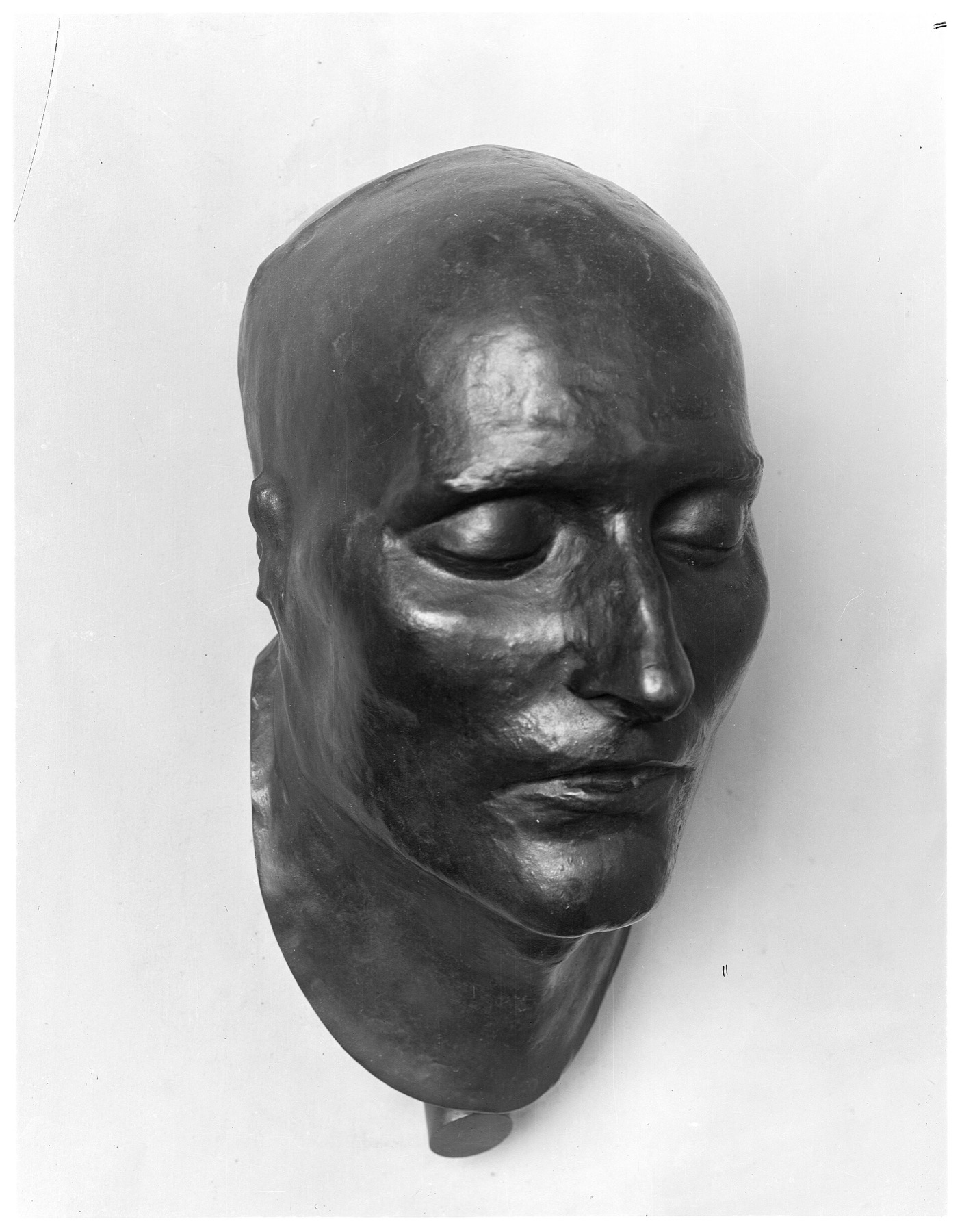
Napoleon died in exile on St Helena on 5 May 1821. A mould of his face was taken soon afterwards, and his physician Francesco Antommarchi later sold plaster and bronze copies under his name, like the bronze cast now in the Metropolitan Museum of Art pictured above. Who actually took the mould, a British army surgeon or Antommarchi, and how faithfully the many later copies follow it, has been argued over ever since. The art historian Suzanne Glover Lindsay places these objects in the wider cult of the dead emperor: the mask became a relic for admirers, long before his body returned to Paris in 1840.
Beethoven: life mask and death mask
The most reproduced “death mask” of all is not one. In 1812 the sculptor Franz Klein made a life mask of Ludwig van Beethoven, then 42, to prepare a portrait bust. Beethoven had to breathe through straws while the plaster set; he disliked the process, and his scowl in the cast is the face of an uncomfortable man rather than a tormented genius. The actual death mask was taken by Josef Danhauser in 1827. It shows a thin, sunken face, distorted because the temporal bones had been removed during the post-mortem to examine the composer’s organs of hearing.
By 1900 the difference had been forgotten by many collectors, and Klein’s mask was sold and hung as a memento of Beethoven’s death. The Beethoven-Haus in Bonn holds both masks in its collections.
The unknown woman of the Seine
One mask is famous precisely because nobody knows whose face it is. According to the story that came with it, a young woman was pulled from the Seine in Paris in the late 1880s and a pathologist at the city morgue was so struck by her face that he made a cast. Copies of L’Inconnue de la Seine hung in artists’ homes across Europe after 1900. Whether she was ever dead is doubtful: her calm, smiling expression is hard to reconcile with drowning, and the cast may have been taken from a living model.
In the late 1950s the Norwegian toymaker Asmund Laerdal used the face for Resusci Anne, the training manikin on which millions of people have since learned mouth-to-mouth resuscitation.
Documented / Disputed
Documented
- Edward III’s funeral effigy (1377) has a face thought to come from a death mask (Westminster Abbey).
- Beethoven’s 1812 mask by Franz Klein is a life mask; his death mask was taken by Josef Danhauser in 1827 (Beethoven-Haus via Google Arts & Culture; Royal Society of Edinburgh).
- Bronze and plaster copies of Napoleon’s death mask were sold under Antommarchi’s name (Metropolitan Museum of Art object).
- Laerdal used the face of L’Inconnue de la Seine for Resusci Anne (Live Science; Museum of Medicine).
Disputed or often repeated
- Who made Napoleon’s mould, and which copy is faithful. Contested since the 1820s.
- Whether L’Inconnue was a drowned woman. The story is unverified; the expression suggests a living model.
- “Beethoven’s death mask” on posters and busts. Usually Klein’s life mask of 1812.
Timeline
- 21 June 1377: Edward III dies; his funeral effigy carries a face thought to be from a death mask.
- 1509: Henry VII dies; his effigy’s head is probably taken from a death mask.
- 1812: Franz Klein makes a life mask of Beethoven.
- 5 May 1821: Napoleon dies on St Helena; a mould of his face is taken soon after.
- 1827: Josef Danhauser takes Beethoven’s death mask.
- Late 1880s: According to the story, the cast of L’Inconnue de la Seine is made in Paris.
- Late 1950s: Asmund Laerdal gives Resusci Anne the face of L’Inconnue.
Sources
Primary sources
- Westminster Abbey, “Funeral and wax effigies”. westminster-abbey.org.
- Westminster Abbey, “Edward III and Philippa of Hainault”. westminster-abbey.org.
- Death mask of Napoleon I, after Francesco Antommarchi, bronze. The Metropolitan Museum of Art. Open-access image.
- Beethoven-Haus Bonn, “Life mask of Ludwig van Beethoven”, on Google Arts & Culture. artsandculture.google.com.
Secondary sources
- Royal Society of Edinburgh, “Facing Beethoven: Literature, sculpture and identity”. rse.org.uk.
- Suzanne Glover Lindsay, “Mummies and Tombs: Turenne, Napoleon, and Death Ritual”, The Art Bulletin 82, no. 3 (2000): 476. doi:10.2307/3051398.
- “How a girl’s ‘death mask’ from the 1800s became the face of CPR dolls”, Live Science. livescience.com.
- Museum of Medicine, “L’inconnue de la Seine, a prototype for the CPR manikin Resusci Anne”. medicine.museum.
Image credits
- Header image: Death mask of Napoleon I, after Francesco Antommarchi: after Francesco Antommarchi, plaster 1821, cast in bronze later. The Metropolitan Museum of Art. Licence: CC0 1.0 (public domain), via Wikimedia Commons.
Related
- Post-Mortem Photography: What Was Real, and What Is Myth
- Victorian Mourning Rituals: Crape, Black Borders and a Queen in Black
Part of Death Customs in Dark History, Documented. How we research and how we use AI: Editorial Standards. Spotted an error? Tell us at contact@macabrechronicle.com; fixes are logged on the Corrections page.
Editor’s note: This article replaces a shorter piece on death masks that first appeared in the Macabre Chronicle section of moleopedia.com. It was rewritten from the sources above and published here on 30 October 2026.
Halloween Picks

10 ft Halloween Inflatable Archway with Built-in LEDs

MGparty 14.5 ft Halloween Inflatable Walk-In Pumpkin House with LED Lights

Max Fun 10-Foot Halloween Dragon and Pumpkin Inflatable Archway with LED Lights
As an affiliate, we earn on qualifying purchases.