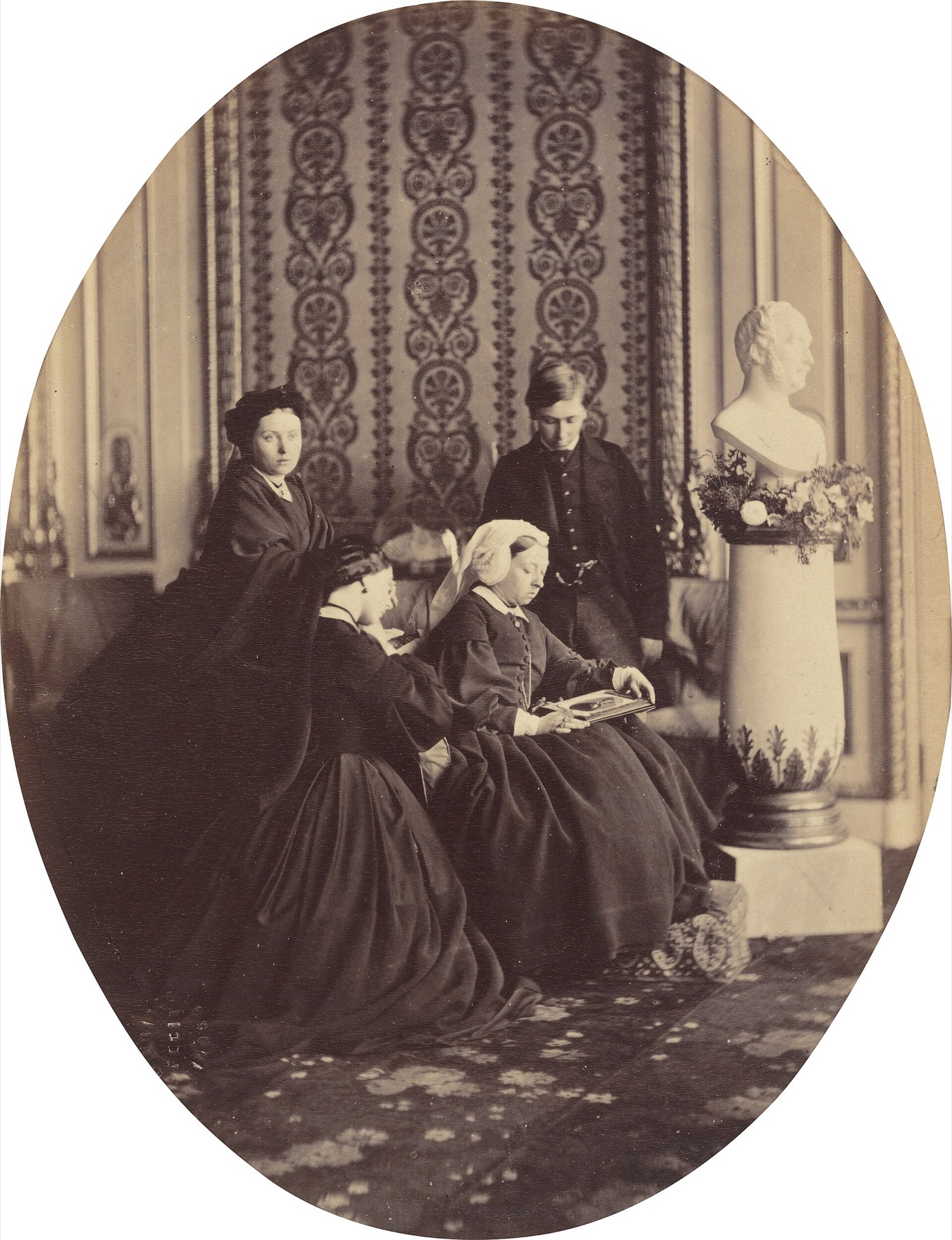
On 14 December 1861 Prince Albert died at Windsor Castle, aged 42. Queen Victoria went into mourning and never fully came out of it. In 1862 she commissioned the photographer William Bambridge to make memorial portraits; under one of them, showing her and her children around a bust of Albert, she wrote “day turned to night”. Two years later, at the wedding of the Prince of Wales in 1863, the court was still in mourning: the Queen watched in her widow’s weeds, and the women guests could wear only grey, lilac or mauve.
Victoria did not invent mourning dress, but her grief gave it a royal model at the moment when fashion magazines, department stores and cheap printing could spread it to everyone. The result was the most elaborate mourning culture in modern history.
At a glance
- Trigger: the death of Prince Albert on 14 December 1861 and the Queen’s lifelong mourning.
- Dress: black crape for deep mourning, moving towards silks and then grey and mauve as time passed.
- Paper: black-bordered stationery whose border narrowed as mourning went on.
- Shops: mourning warehouses such as Jay’s in London’s Regent Street (founded 1841) sold everything needed in a few hours.
A royal example
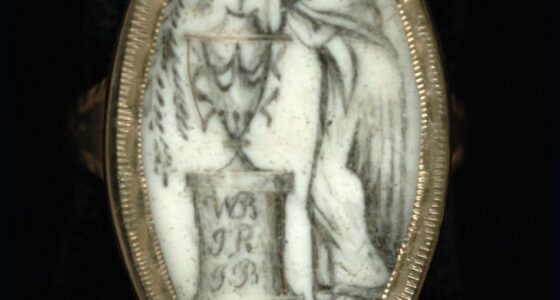
The Royal Collection preserves much of the Queen’s private mourning: memorial photographs, notes about Albert’s final illness, a dried flower from the wreath on his coffin, and a memorial ring holding a tiny photograph of him. Victoria also changed the look of widowhood itself. Richard Davey, writing in 1889, noted that when she became a widow she modified the conventional English widow’s cap with a point over the forehead in the style of Mary, Queen of Scots, a shape that was copied by her subjects and by royal widows abroad.
Her example mattered because it was visible. As Jessica Regan of the Metropolitan Museum of Art put it for the museum’s 2014 exhibition Death Becomes Her, elaborate standards of mourning set by royalty spread across class lines through fashion magazines.
Dressing for grief
Mourning dress followed a sequence. The deepest stage called for dull black wool and crape, a crimped silk with a matte surface that did not reflect light. As time passed, the mourner moved to plainer black silks, and later to grey, lilac and mauve, often called half mourning. The Met’s exhibition traced exactly this progression in women’s clothes from 1815 to 1915, from crape to corded silks to the later introduction of colour.
How long each stage lasted depended on the relationship to the dead person and on which etiquette guide a family followed. Widows were expected to mourn longest. The rules were never one law but a market of advice, and they were stricter for women than for men.
Black borders
Letters showed mourning too. Stationery with a black border told the reader that the writer was in mourning. According to the Shapell Manuscript Foundation, the custom goes back to the 17th century but became popular in the Victorian era: a mourner began with a thick border that narrowed over time. Mark Twain’s calling card in 1902 still carried a broad border, probably for his daughter Susy, who had died six years earlier. The Foundation also warns that the width is no reliable way to date a death: custom varied and was subjective.
The mourning business
All this created a trade. Mourning warehouses sold ready-made black clothing, crape, gloves, hat bands, jewellery and stationery. Jay’s London General Mourning Warehouse on Regent Street, founded in 1841, was the best known. Its own history of mourning, written by Richard Davey and published at Jay’s in 1889, praised such shops as places where people “in the haste of grief can obtain in a few hours all that the etiquette of civilisation requires for mourning”. It was, of course, also an advertisement.
The culture faded after 1900. The death of Victoria herself in 1901 brought one last great public mourning; the mass deaths of the First World War made full mourning dress impractical and, for many, inappropriate. By 1921 the American etiquette writer Lillian Eichler Watson was calling a black border nearly an inch wide “in bad taste”.
Documented / Disputed
Documented
- Albert died on 14 December 1861; Victoria commissioned memorial photographs in 1862 and the court was still in mourning at the 1863 royal wedding (Royal Collection Trust).
- Mourning dress moved from crape to silks to grey and mauve (Metropolitan Museum of Art, Death Becomes Her).
- Black-bordered stationery narrowed over the course of mourning (Shapell Manuscript Foundation).
- Jay’s mourning warehouse dates from 1841 (Davey, 1889).
Disputed or often repeated
- Fixed mourning periods. Tables listing exact months for each relative come from individual etiquette guides; practice varied by class, region and family.
- Dating a death by the width of a black border. Unreliable; custom varied (Shapell).
- “Victorians were obsessed with death.” They lived with high mortality and made mourning visible; the commercial pressure behind it was also real, as Jay’s own book shows.
Timeline
- 1841: Jay’s London General Mourning Warehouse opens in Regent Street.
- 14 December 1861: Prince Albert dies at Windsor Castle.
- 1862: Victoria commissions memorial photographs from William Bambridge.
- 10 March 1863: At the wedding of the Prince of Wales the court is still in mourning.
- 1889: Richard Davey’s A History of Mourning is published at Jay’s.
- 22 January 1901: Queen Victoria dies.
- 1921: Lillian Eichler Watson calls very wide black borders “in bad taste”.
Sources
Primary sources
- Royal Collection Trust, “Queen Victoria, the Crown Princess of Prussia, Princess Alice and Prince Alfred in mourning”, RCIN 2900545. rct.uk.
- Royal Collection Trust, “The marriage of the Prince of Wales to Alexandra of Denmark, 10 March 1863”, RCIN 921008. rct.uk.
- Richard Davey, A History of Mourning (London: Jay’s, 1889). Project Gutenberg.
- William Bambridge, Queen Victoria in Mourning, 1862. National Gallery of Art, Washington. Open-access image.
Secondary sources
- The Metropolitan Museum of Art, Death Becomes Her: A Century of Mourning Attire (exhibition, 21 October 2014 – 1 February 2015). metmuseum.org.
- Shapell Manuscript Foundation, “Mourning Stationery in 19th Century America”. shapell.org.
- Lou Taylor, Mourning Dress: A Costume and Social History (George Allen and Unwin, 1983). Catalogue record.
Image credits
- Header image: William Bambridge, Queen Victoria in Mourning: William Bambridge, 1862. National Gallery of Art, Washington. Licence: CC0 1.0 (public domain), via Wikimedia Commons.
Related
- Mourning and Memento Mori Jewelry: Rings, Hair and Whitby Jet
- Post-Mortem Photography: What Was Real, and What Is Myth
- Death Masks: Faces Cast After the Last Breath
Part of Death Customs in Dark History, Documented. How we research and how we use AI: Editorial Standards. Spotted an error? Tell us at contact@macabrechronicle.com; fixes are logged on the Corrections page.
Editor’s note: This article replaces three shorter pieces on Victorian mourning rituals and mourning stationery that first appeared in the Macabre Chronicle section of moleopedia.com. It was rewritten from the sources above and published here on 30 October 2026.
Halloween Picks

MGparty 14.5 ft Halloween Inflatable Walk-In Pumpkin House with LED Lights

Gemmy Bluey Family Halloween Inflatable Scene, 5.5 ft Lighted Yard Decoration

8.5 Foot Halloween Inflatable Haunted House Castle with Skeleton, Ghost & Skulls
As an affiliate, we earn on qualifying purchases.