In Aristophanes’ comedy The Frogs, staged in Athens in 405 BC, the god Dionysus asks how to reach the underworld. Heracles tells him he will come to a vast lake, where “an aged mariner will take you over, and take two obols for your fare”. Two thousand years later the idea is everywhere: the Greeks, we are told, put a coin in the mouth of the dead so that Charon would ferry them across.
There is something to the story, and archaeology can test it. Coins and other objects buried with the dead tell us what people expected the dead to need, and what the living wanted to show. They also show how often popular explanations simplify a messy reality.
At a glance
- Grave goods: objects placed with the dead, from food and tools to jewellery, weapons and coins.
- Charon’s obol: a coin left with the dead in parts of the Greek and Roman world, linked in literature to the ferryman’s fare.
- The evidence: coins appear in a minority of ancient graves, in the mouth, hand or elsewhere, and their meaning varied.
- Sutton Hoo: the early 7th-century ship burial held a purse with 37 gold coins, three blank coins and two small ingots.
Why bury objects with the dead?
Grave goods are among the oldest evidence of human ritual. Archaeologists read them in several ways at once: as provisions for a journey or an afterlife, as personal belongings that stayed with their owner, as gifts from mourners, and as a public statement about the status of the dead and of the family that buried them. The same object can mean different things in different places, which is why archaeologists are cautious about one-size-fits-all explanations.
Charon’s obol: what the graves show
The classicist Susan T. Stevens surveyed the archaeological evidence for coins in Greek and Roman graves in a study published in 1991. Coins do turn up with the dead, sometimes in the mouth, sometimes in a hand or elsewhere in the grave, and the custom is attested over many centuries and a wide area. But coins are found in only a minority of burials, the practice was far from universal, and literary explanations such as the ferryman’s fare are only part of the picture: coins could also be offerings, protective tokens or simply valuables that belonged to the dead.
In other words, “the Greeks paid Charon with a coin under the tongue” is a real custom turned into a rule. Many Greeks were buried without any coin at all, and the people who did leave one may not all have been thinking of the ferryman.
Sutton Hoo: gold for the journey?
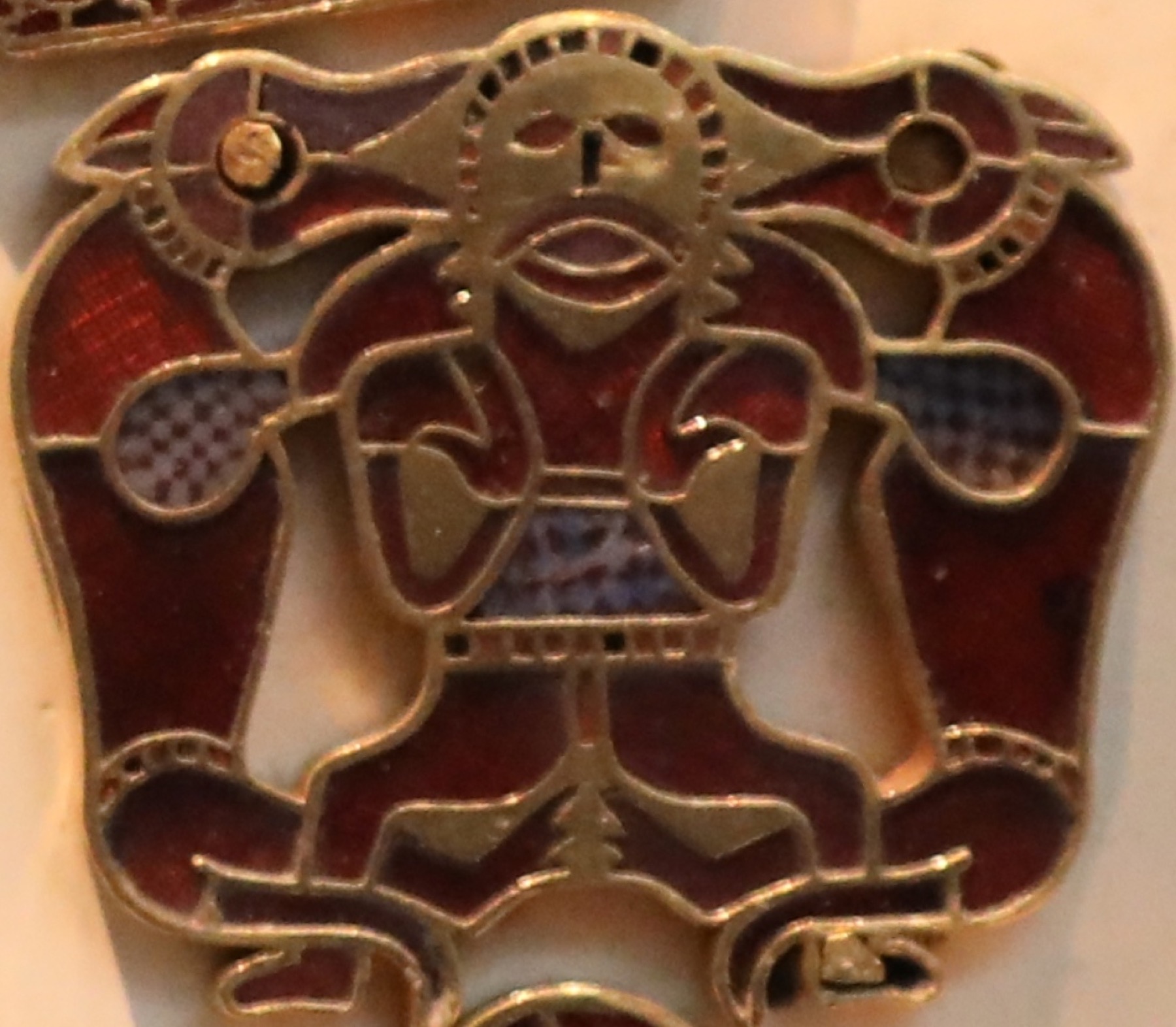
In 1939 the excavation of Mound 1 at Sutton Hoo in Suffolk revealed the impression of a 27-metre ship holding one of the richest burials ever found in Britain, probably of an East Anglian king of the early 7th century. Among the finds was a purse with a gold and garnet lid. Inside lay 37 gold coins from the Merovingian kingdoms of Francia, three blank gold coins and two small gold ingots, as recorded in the first published summary of the coins in 1940.
The coins matter because they help to date the burial. Their interpretation is another matter. One popular theory reads the 40 objects as payment for 40 ghostly oarsmen, with the ingots for the steersman: an Anglo-Saxon version of Charon’s fare. It is an attractive idea, but it cannot be proven, and the purse may simply have held a king’s treasure.
Documented / Disputed
Documented
- Aristophanes’ Frogs (405 BC) makes the ferryman’s fare two obols (Perseus text).
- Coins are found in a minority of Greek and Roman graves, in varying positions (Stevens 1991).
- The Sutton Hoo purse held 37 Merovingian gold coins, three blanks and two small ingots (Crawford 1940; National Trust).
- The ship burial in Mound 1 was excavated in 1939 (National Trust).
Disputed or often repeated
- “Every Greek was buried with a coin.” No; coins are found in a minority of graves.
- “The coin always went under the tongue.” Coins are found in the mouth, in the hand and elsewhere.
- Coins on the eyes. The popular image does not match the ancient evidence, which mostly comes from coins in the mouth or hand.
- Sutton Hoo’s “40 oarsmen”. An interpretation, not a fact. The coin count fits it, but nothing proves it.
- Who was buried at Sutton Hoo. Usually identified with King Rædwald of East Anglia (died about 624), but no inscription names him.
Timeline
- 405 BC: Aristophanes’ The Frogs is staged in Athens, with Charon’s two-obol fare.
- Classical to Roman period: Coins are placed with some of the dead across the Greek and Roman world.
- Early 7th century AD: A ship burial is raised in Mound 1 at Sutton Hoo, with a purse of Merovingian gold coins.
- 1939: Mound 1 at Sutton Hoo is excavated.
- 1940: The first summary of the Sutton Hoo coins is published in Antiquity.
- 1991: Susan T. Stevens publishes her survey of coins in ancient funerary practice.
Sources
Primary sources
- Aristophanes, The Frogs, around line 140 (English translation). Perseus Digital Library.
- O. G. S. Crawford, “The Sutton Hoo Ship-Burial. VI. The Coins: A Summary”, Antiquity 14, no. 53 (1940): 64–68. doi:10.1017/s0003598x00014794.
Secondary sources
- Susan T. Stevens, “Charon’s Obol and Other Coins in Ancient Funerary Practice”, Phoenix 45, no. 3 (1991): 215–229. doi:10.2307/1088792.
- National Trust, “History of Sutton Hoo”. nationaltrust.org.uk.
Image credits
- Header image: Purse lid from the Sutton Hoo ship burial, British Museum: Geni, 2017. Licence: CC BY-SA 4.0, via Wikimedia Commons.
Related
Part of Death Customs in Dark History, Documented. How we research and how we use AI: Editorial Standards. Spotted an error? Tell us at contact@macabrechronicle.com; fixes are logged on the Corrections page.
Editor’s note: This article replaces three shorter pieces on grave goods and Charon’s obol that first appeared in the Macabre Chronicle section of moleopedia.com. It was rewritten from the sources above and published here on 30 October 2026.