
TL;DR
In Gothic fiction, houses and ruins shape the action: they limit movement, guard secrets, and bring the past into the present. Track who can enter each room, what the building conceals, and how its condition changes, and you can read architecture as part of the plot rather than as scenery.
A Gothic house can do more than creak in the night. It can decide who gets to speak, who stays locked away, and which family story survives. In these books, the floor plan often carries as much suspense as the characters do.
This guide shows you how to read Gothic fiction through its houses, rooms, and ruins. You’ll see how a locked door can mark a boundary of power, why a decaying mansion makes the past feel close, and how an ordinary home can become frightening when its history turns against its residents.
Try a simple habit as you read: notice who controls each space, what remains hidden, and what changes when someone crosses a threshold. The building may be keeping secrets. It may also be telling you who has the power to keep them.
Treat the house as part of the plot when its layout changes what characters can know, reach, or choose.
For every locked or hidden room, track who controls access and who is excluded.
Read a ruin as a visible trace of history, then distinguish confirmed events from characters’ suspicions.
Hold psychological and supernatural readings open when the story leaves the cause uncertain.
Modern homes, hotels, and apartments can create Gothic unease through secrecy, surveillance, isolation, or buried history.
A reader’s field guide · Gothic architecture
Reading Gothic Fiction Through Its Houses, Rooms, and Ruins
A Gothic building does more than set the mood. It can limit movement, guard secrets, and bring the past into the present. Follow who controls each space—and the floor plan starts to read like part of the plot.
Why Gothic Houses Feel Like Characters
A house directs movement, limits knowledge, and presses a family’s past into the present. Its condition and authority can make it shelter for one person and confinement for another.
The house watches
Windows, portraits, and corridors can make inhabitants feel observed, trapped, or threatened. Decay may echo a family’s decline or a character’s distress.
The house withholds
Locked doors, hidden passages, attics, and basements turn space into a map of secrets. Who is kept outside can signal class, gender, or social power.
The past remains
Ruined buildings leave traces of lost authority, conflict, violence, inheritance, or injustice that the present may have tried to bury.
A grand house may offer protection to its owner and confinement to someone who lives or works there. Treating architecture as evidence helps reveal whose history the building preserves and whose it excludes.
Read the Gothic Floor Plan
Turn a vague feeling of unease into practical questions. You do not need a complete map: a few notes about access, secrecy, and change can follow the plot.
Map access
Who has keys? Who needs permission? Who moves freely? A servant’s route or a character barred from an upstairs floor can reveal household rules before anyone explains them.
Mark secrets
Note locked doors, sealed rooms, hidden passages, attics, and basements. Record who knows each space exists—and who is denied the knowledge.
Watch for change
Does a room open after a death, argument, inheritance, or discovery? Does a once-grand house deteriorate? A fresh opening or collapse can bring the past into the present.
A quick margin map
Label only the spaces that matter to the action, then update their meaning as people move through them.
- FForbidden: someone is explicitly kept out.
- SShared: access depends on household rules.
- PPrivate: one person controls the space or its story.
What a Locked Room Reveals About Power
A lock can guard knowledge, safety, or a person’s freedom. Ask who holds the key, who is kept outside, and who benefits from the silence. The room may be eerie, but its rules can also be political. In Charlotte Brontë’s Jane Eyre, Thornfield Hall’s hidden room and concealed history connect the house directly to the novel’s conflicts over marriage, secrecy, and autonomy.
Attic
A hidden upper room may place someone outside the household’s respectable story. Look at its occupants and rules before assigning it a fixed meaning.
Basement
A basement may conceal storage or the labor that keeps an elegant home running. Notice what the household wants out of daily view.
Corridor
A passage can guide someone toward discovery or escape, while a locked threshold makes dependence visible. Having a home is not the same as having authority over it.
Architecture Changes the Threat
Gothic settings shift across periods, from medieval strongholds to country houses, decaying mansions, and ordinary modern buildings. The unease travels with them.
The Castle of Otranto
Horace Walpole’s castle helped establish a setting for family secrets, dynastic conflict, and supernatural disturbance. Its rooms and corridors make inherited history feel physically present.
Thornfield Hall
In Jane Eyre, hidden space and concealed history put architecture at the center of secrecy, marriage, and autonomy.
The Haunting of Hill House
Shirley Jackson makes disorienting spaces part of the psychological horror. The house’s layout affects how its inhabitants experience what is happening.
A suburban home, hotel, hospital, or apartment can become frightening through secrecy, surveillance, isolation, or buried history. Familiar space can feel dangerous when its past turns against its residents.
How a Ruin Makes the Past Feel Present
A broken arch or roofless chapel leaves visible traces of an institution that once held power. Its damage invites questions; it does not provide a complete record of what happened.
A ruined abbey may suggest lost religious authority, inheritance, conflict, or a vanished community. Ask who built the site, who uses it now, and whether the story offers a family legend or evidence characters can verify. A traveler crossing an overgrown churchyard to reach an old estate encounters more than an atmospheric view: the landscape places buried history along the route into the present.
When the House Might Be Haunted
Gothic fiction often leaves the cause of unease unresolved. A haunting may be literal, psychological, social—or deliberately difficult to separate.
A presence in the house
Does the story provide evidence of an external force, or only a character’s interpretation of events?
A mind under pressure
Do confusing corridors and hidden rooms echo fear, memory, or distress? Consider this reading alongside what the house materially enables.
A real structure of power
Who owns the building, works inside it, or is confined by its rules? A house can embody actual control and inherited privilege.
Modern Gothic criticism also asks whose histories official accounts leave out, and how gender, class, race, colonial history, and the environment shape built space. For claims about the newest scholarship, check current academic publications.
Why Gothic Houses Feel Like Characters
Reading Gothic fiction gets easier when you treat the house as an active force: it directs movement, limits knowledge, and presses a family’s past into the present. Its doors, windows, and decaying walls shape what characters can do. That makes the building part of the plot, not a painted backdrop.
Horace Walpole’s The Castle of Otranto helped establish the Gothic castle as a place of family secrets, dynastic conflict, and supernatural disturbance. The castle matters because its authority feels physical: rooms and corridors place characters inside a history they did not choose. When you read a castle scene, ask what the building allows its owner to control and what it lets that owner conceal.
Later Gothic fiction shifts from medieval strongholds to country houses, decaying mansions, and homes that appear ordinary from the street. The change in architecture changes the flavor of the threat. A distant castle promises isolation; a familiar house suggests that danger may be tucked behind a door you would normally leave open.
Imagine arriving at a family mansion where the roof leaks over portraits of stern ancestors. Before anyone explains the family conflict, the water stains and watching faces have already made decline visible. The house shows you the family’s history in material form. What seems like atmosphere can be evidence.
A Gothic building does not merely hold the story. It helps decide what the story can reveal.
Keep an eye on the house’s condition and authority together. Who owns it? Who maintains it? Who is allowed to change it? A grand house may offer shelter to one character and confinement to another. Architecture can signal privilege and dependence in the same hallway.
Popular right now

KitchenAid Classic Series 4.5-Quart Tilt-Head Stand Mixer, Onyx Black

Philips 2200 Series Fully Automatic Espresso Machine with Classic Milk Frother

Ninja Foodi Smart Dual Heat Air Fry Oven, 13-in-1, Silver (SP351)
As an affiliate, we earn on qualifying purchases.
Use This Three-Step Method to Read a Gothic Floor Plan
To read a Gothic floor plan, track access, secrecy, and change: note who can enter each space, what remains hidden there, and how the building’s condition shifts as the story unfolds. These three questions turn a vague feeling of unease into a practical way to follow the plot.
- Map access. Notice who has keys, who needs permission, and who moves freely. If a servant can enter a room while a family member cannot, that detail may reveal a household’s rules before anyone states them.
- Mark secrets. Write down locked doors, sealed rooms, hidden passages, attics, and basements. Beside each, record who knows it exists. A secret place becomes more suspenseful when the reader knows someone is being kept away from it.
- Watch for change. Does a room become accessible after a death, inheritance, argument, or discovery? Does a once-grand house grow more damaged? A new opening or fresh collapse can signal that the past has altered the present.
Here’s a useful reading scenario: a character hears footsteps overhead but has no access to the upper floor. Rather than jumping straight to a supernatural explanation, ask who controls the stairs, what the character has been told about the floor, and what practical evidence the scene supplies. Restricted access creates suspense whether the explanation is ghostly, psychological, or social.
You can keep a tiny map in the margin without drawing every corridor. Use a few labels—“forbidden,” “shared,” “private”—and update them as characters move. When the same room changes meaning over time, that shift often matters more than its wallpaper.
What a Locked Room Reveals About Power
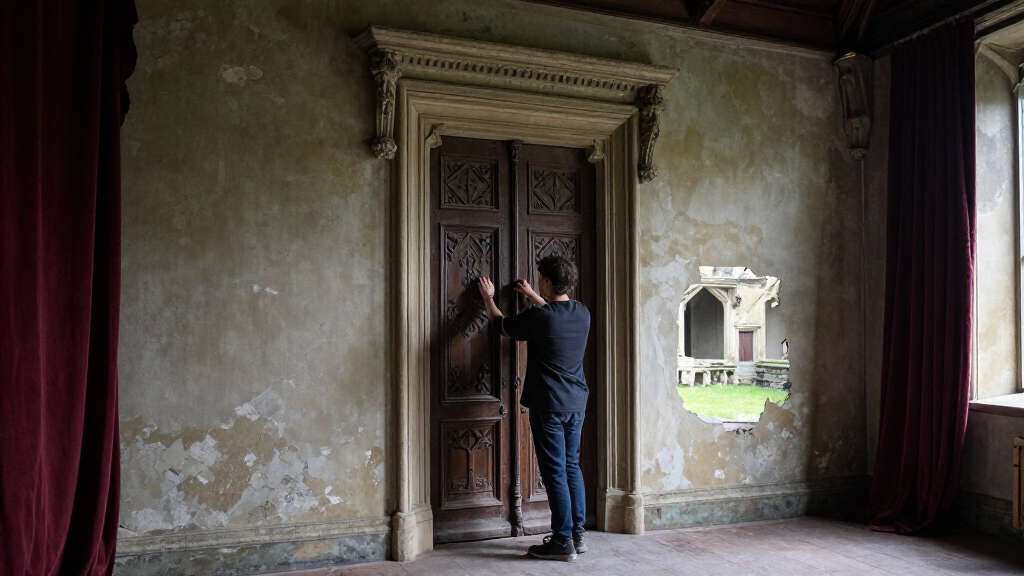
A locked room in Gothic fiction signals that someone controls access to knowledge, safety, or a person’s freedom. The lock may guard a family secret, but it also raises practical questions: who holds the key, who is kept outside, and who benefits from the silence? Those answers can make a room feel political as well as eerie.
In Charlotte Brontë’s Jane Eyre, Thornfield Hall’s hidden room and concealed history make the house central to the novel’s questions about marriage, autonomy, and secrecy. The room matters because it connects private architecture to public consequences. As you read, follow the chain between what the household hides and what its characters are free to decide.
Attics and basements often sit at opposite ends of a building, but both can hold what the household wants outside its daily view. A locked attic may suggest exclusion from the family’s respectable story; a basement can hide the labor or storage that keeps an elegant home running. The meaning depends on the work. A room is not a universal symbol; its occupants, rules, and history give it force.
For a concrete reading test, list each restricted space and its gatekeeper. If one person controls a key, a servant controls the practical route, and a third person is denied any explanation, the room has already mapped a power imbalance. Who can enter becomes as revealing as what they find.
Gothic fiction often makes domestic architecture especially charged for women, who may live in a house without controlling it. A corridor can guide someone toward escape, while a locked chamber can make dependence visible. Look for the difference between having a home and having authority over it.
How a Ruined Abbey Makes the Past Feel Present
A ruin makes the past feel present by leaving visible traces where a living institution once held power. A broken arch or roofless chapel is not a complete record of what happened there, but its damage invites you to ask what ended, who remembers it, and whose account the present has kept. In Gothic fiction, decay gives history a place to stand.
A ruined abbey can suggest lost religious authority, inheritance, conflict, or a community’s disappearance. Its stones may be picturesque by daylight and unsettling at dusk, but the mood is only one layer. Ask who built the site, who uses it now, and whether the story treats its history as a family legend or as something the characters can actually verify.
Consider a traveler crossing an overgrown churchyard to reach an old estate. Ivy covers the carvings, rain collects in the window openings, and the route passes through a structure that no longer serves its original purpose. The scene gives the reader a tactile contrast: the building has fallen, but its influence remains in local memory, claims to land, or a household’s ideas about itself.
That contrast makes ruins useful for reading historical conflict. A family might tell a polished story about its origins while the damaged building nearby suggests an older, messier past. You do not need to treat every ruin as proof of a specific crime. Instead, separate what the text confirms from what characters suspect, and notice whether uncertainty is part of the design.
When you reach a ruin, look for what the narrative chooses to preserve: a name, an inscription, a doorway, or a route through the grounds. What survives shapes what characters can remember. The ruin becomes a test of whether the present will face that memory or simply admire the scenery.
Why Gothic Houses Can Feel Haunted Without a Ghost
A Gothic house can feel haunted without a confirmed ghost because secrecy, memory, and fear give familiar spaces a threatening history. In some stories, the supernatural is real within the plot; in others, a character’s uncertainty does the work. Gothic fiction often leaves room for both readings, so separate what the text shows from what it invites you to suspect.
Shirley Jackson’s The Haunting of Hill House makes the house’s disorienting spaces part of its psychological horror. The building’s layout contributes to unease, so you can track how physical confusion and a character’s experience interact. Is a hallway described as impossible to navigate? Does the scene offer another character’s view? Those details help you notice how the book builds doubt without flattening it into one answer.
Reading a house as a reflection of the mind can be fruitful, but it should not erase the house itself. A confusing corridor may suggest inner turmoil while also trapping someone in a real physical space. Likewise, a locked room might carry symbolic meaning and still have a literal gatekeeper with a literal key. The metaphor does not cancel the material conditions.
Think of an apparently ordinary apartment where every neighbor can hear the elevator, the landlord holds the spare key, and the front door faces a brightly lit hallway. No castle required. Surveillance and lack of privacy can make a modern home feel exposed, while an old family story can make each threshold seem loaded.
Ask two questions together: “What does the house make the character feel?” and “What does the house let the character do?” The first follows atmosphere; the second follows power. Holding both questions open keeps the uncanny alive and stops your reading from reducing every threat to either a ghost or a mood.
How to Spot the Difference Between a Gothic Setting and a Gothic Plot
A Gothic setting becomes part of the plot when the building changes what characters know, choose, or can reach. A castle can look dramatic without affecting the action; a modest house can become deeply Gothic if its boundaries control access to a secret or its history changes a character’s choices. The test is cause and effect.
Compare a character who merely admires a mansion’s iron gate with one who cannot leave because the gate is locked and the only key belongs to someone else. The first detail colors the scene. The second shapes the action. Architecture matters most when it creates a consequence. Note whether a door delays a discovery, a stairwell separates characters, or a ruin redirects someone’s route.
Use this compact comparison while you read:
| What you notice | Setting as backdrop | Setting as plot force |
|---|---|---|
| A door | Its carved wood adds atmosphere. | It blocks access to evidence or escape. |
| A room | Its dust and portraits establish age. | Its restricted use changes who can know the truth. |
| A ruin | It makes the landscape feel old. | Its history complicates a claim, inheritance, or family story. |
| A house | It gives characters a place to gather. | Its layout separates, confines, or exposes them. |
For example, if a character finds an old letter in a room they were forbidden to enter, the discovery joins physical access to new knowledge. If the same letter arrives openly by post, the house may still be atmospheric, but the architecture has less to do with the reveal.
This distinction helps you avoid forcing symbolism onto every cracked tile. Look for the building’s effect on choices. If a wall, doorway, or boundary changes the next scene, architecture has entered the machinery of the story.
Where Contemporary Gothic Unease Hides in Ordinary Buildings
Contemporary Gothic unease can grow in any building that makes secrecy, surveillance, isolation, or unresolved history hard to escape. A castle is one route into the mode, but it is not a requirement. An apartment block, hotel, hospital, or suburban home can carry Gothic tension when its familiar spaces begin to feel strange or controlled.
Picture a family moving into a clean suburban house where every window faces another home, but nobody speaks about the previous residents. The lawn is trimmed and the hallway smells faintly of fresh paint. That polished surface can sharpen unease: the threat has no obvious ruin to warn you, so every silence and unexplained rule draws attention.
Hotels and hospitals bring their own kinds of unease through temporary rooms, controlled access, and unfamiliar routines. In a hotel, you may know the room number but not the building’s history; in a hospital, you may be physically close to others while having little control over where you go. A story can turn those ordinary conditions into Gothic pressure without claiming that every building of that type is frightening.
These settings also invite you to ask who owns a place, who works there, and whose history its official story leaves out. A renovated house may look new while a story’s conflicts stem from land, family, or past use. Surface renewal does not automatically erase history. Pay attention to what residents know, what workers see, and whose version becomes the accepted one.
When reading Gothic fiction through its houses, rooms, and ruins, start with concrete details: access, condition, and memory. A key in one person’s pocket, a room left untouched, or a familiar corridor that no longer leads where expected can tell you where the tension lives. The building’s shape makes the story’s pressure visible.
Frequently Asked Questions
Why are houses so important in Gothic fiction?
Houses gather family history, social rules, and hidden knowledge in one physical place. Their rooms and boundaries can shape what characters are allowed to know or do, as Thornfield Hall does in Jane Eyre.
What does a locked room mean in a Gothic novel?
A locked room may hold forbidden knowledge, mark someone’s exclusion, or show who controls a household. Its meaning depends on who holds the key, who is kept out, and what the room’s history adds to the plot.
Are Gothic houses always haunted by ghosts?
No. Some Gothic stories include literal supernatural threats; others make a house feel haunted through memory, fear, secrecy, or unresolved conflict. Many works leave the boundary uncertain.
What do ruins represent in Gothic fiction?
Ruins can suggest lost power, failed institutions, historical conflict, or a past the present would rather forget. Look at what the story says about the ruin and what its characters merely assume.
Does Gothic fiction need a castle or mansion?
No. An ordinary home, hotel, or apartment can create Gothic tension when isolation, secrecy, surveillance, decay, or a threatening history changes how people move and feel inside it.
Conclusion
When a Gothic novel makes you uneasy, look at the floor plan before you settle on an explanation. Ask who has the key, which room holds the missing story, and what the building’s decay remembers. Architecture turns hidden pressure into something you can walk through.
Keep that map in mind as you read: a door swings open, a corridor narrows, and the past waits just beyond the threshold.