
TL;DR
The best objects for a Gothic curiosity cabinet pair natural textures, such as shells and minerals, with scholarly pieces like old books, maps, and brass instruments. Group objects by theme, vary their height, leave breathing room, and use warm, indirect light. Reproductions and contemporary crafts can create the same atmosphere as antiques when you describe them honestly and protect delicate materials.
A single pale fossil can make a dark cabinet feel older than the house around it. Set it beside a brass compass and a small, worn book, and suddenly the shelf suggests a journey, a study, a question left open.
A curiosity cabinet, also called a cabinet of curiosities, is a collection of unusual natural, scientific, historical, and artistic objects. European cabinets were popular from the Renaissance through the 18th century, when collectors arranged such things to provoke wonder and invite close inspection [1]. You can borrow that spirit for a Gothic interior without turning your room into a crowded prop shop.
This guide helps you choose pieces that reward a closer look, arrange them so each one has room to speak, and care for delicate materials. You’ll also find ways to create an atmospheric display with replicas and contemporary objects, while treating provenance and sensitive materials with care.
Choose objects that share a theme, material, or color, such as shells and minerals for a nature shelf.
Pair natural specimens with books, maps, or brass instruments to suggest a thoughtful study.
Use trays, cloches, and small compartments to give keys, coins, and cameos a clear place.
Choose reproductions when provenance or the rules for wildlife materials and human remains are unclear.
Keep paper and organic specimens out of direct sunlight, and use warm, indirect light for the display.
Field guide · Gothic interiors
Best Curiosity Cabinet Objects for a Gothic Interior
Pair natural textures with scholarly pieces to build a display that feels like an old study: shells beside maps, minerals beside brass, and every object given room to invite a closer look.
A single pale fossil can make a dark cabinet feel older than the house around it.
Atmosphere in one object01 / The collection
Objects that tell a small story
A curiosity cabinet is a collection of unusual natural, scientific, historical, and artistic objects, arranged to provoke wonder and close inspection. For a Gothic interior, choose pieces that share a texture, color, or imagined subject so the cabinet feels collected rather than crowded.
Natural history
Texture from nature
Irregular shapes bring contrast to dark wood, glass, and polished metal. Try familiar forms with tactile detail.
Scientific study
Tools for discovery
Instruments imply observation and travel. Set one near a specimen to give the pairing a reason to exist.
Printed matter
Evidence of a mind
Dark bindings and aged paper establish a scholar’s corner. Facsimiles can provide the same visual warmth.
Small histories
Artifacts with patina
Contain small finds so they read as a considered collection. Label uncertain histories plainly.
Symbolic objects
Memento mori motifs
Hourglasses, skull imagery, and funerary art bring a reflective note. Choose reproductions or documented, legal pieces.
Natural history display
Models and replicas
Taxidermy and anatomical models can be striking. Clear provenance, conservation, and non-animal alternatives matter.
02 / Arrange the shelves
Collected, not crowded
Start with a short story: a shell for the sea, a mineral for a distant landscape, and a worn book suggesting careful study. Connect objects with a shared palette or theme, then vary their heights and leave darkness around the focal pieces.
Use stands for height, trays for small finds, and a cloche for fragile or especially striking objects. A contemporary print can sit beside an inherited key and a clearly identified fossil replica; the visual thread is enough.
sea & tide
field notes
exploration
stone
03 / A simple styling sequence
Build the atmosphere in four moves
A convincing display comes from relationships between objects. Let one piece lead, and give every supporting piece a clear role.
Choose a thread
Pick a theme, material, or color: tides and stone, exploration, or the botanist’s desk.
Set a focal piece
Give the most distinctive silhouette its own space and a slightly elevated position.
Layer the scale
Balance a tall book or globe with small objects gathered in a tray or compartment.
Light with care
Use warm, indirect light to reveal texture while keeping fragile materials out of sun.
04 / The balance
What gives a cabinet its Gothic character?
Use the visual mix as a guide when selecting and arranging a small collection. The bars show relative emphasis for this styling approach, not measured historical data.
Styling priorities distilled from the guide: combine varied textures with scholarly objects, thoughtful spacing, and honest descriptions.
05 / Care and collecting
Protect the mystery, respect the materials
Atmosphere does not depend on rarity or age. Reproductions, family keepsakes, found natural objects, and contemporary craft can sit together when they share a palette and are described honestly.
Light & handling
Keep delicate pieces stable
Strong sunlight can fade paper, textiles, and organic specimens. Use a glass-fronted cabinet, warm indirect light, and a stable spot away from sharp humidity swings. Avoid frequent handling of fragile surfaces.
Provenance & ethics
Choose with clear origins
Rules for wildlife materials, fossils, antiquities, and human remains vary by location. Check documentation and local requirements. If an origin is unclear, select a replica or handmade substitute.
Books & paper
Display without strain
Keep fragile paper out of strong sun and do not force a stiff or valuable book open. A facsimile or botanical print can bring the same paper-and-ink warmth with less risk.
Honest labels
Let the real story show
Use labels such as “reproduction compass” or “iron keys, origin unknown.” A museum-like presentation feels evocative without inventing an owner, expedition, or age.
Start with objects that tell a small story
The best curiosity cabinet objects for a Gothic interior feel as if they belong to the same imaginary study: a place where someone reads maps by lamplight and keeps specimens from a long journey. Choose a few objects with distinct textures and shapes, then connect them through a shared color, material, or theme. That gives you atmosphere and a story without requiring every piece to be old.
Think of the cabinet like a short story rather than a warehouse. A shell can suggest the sea, a mineral specimen can suggest a distant landscape, and a handwritten-looking label can hint at careful study. In one shelf, these objects might form a collection about tides and stone. In another, a small globe, a brass compass, and a folded map could make exploration the theme.
European curiosity cabinets gathered objects from nature, science, history, and art to invite wonder and close inspection [1]. That mix is part of their appeal, but you don’t need to reproduce any one collector’s cabinet. A modern display can pair a contemporary print with an inherited key and a clearly identified fossil replica. The honest connection is the visual and intellectual thread, not a made-up history.
As you collect, ask what each piece adds. Does it change the silhouette, introduce a new texture, or give another object a reason to be there? A small collection of five to eight well-spaced pieces can feel more compelling than a shelf packed edge to edge. Leave a little darkness around the objects; the empty space helps the eye settle.
Popular right now

Ninja Crispi Glass Air Fryer (Stone) – 4‑in‑1

Samsung 75-Inch M80H Series Mini LED 4K Smart TV (2026)

Dyson V8 Cyclone Cordless Vacuum
As an affiliate, we earn on qualifying purchases.
Choose natural specimens for texture and contrast
Natural history specimens are strong choices because their textures bring an irregular, tactile counterpoint to polished glass and dark wood. For a Gothic cabinet, try shells, fossils, minerals, or preserved botanical samples, and use ethically sourced feathers or bones only when their origin is clear. Each offers a different shape: a spiral shell, a branching mineral, a pressed leaf, or the quiet geometry of a fossil.
Imagine a cabinet with black-stained shelves and a small brass stand. A chalky ammonite replica could sit beside a smooth, smoky quartz specimen and a pressed fern in a protective frame. The contrast works like a drumbeat: rough, reflective, delicate. You get visual variety without needing anything startling or rare.
Before bringing a natural object home, consider its provenance and care needs. Laws and collecting rules for wildlife products and fossils vary by location, so check the documentation and local requirements for regulated materials [2]. If you can’t verify an item’s origin, a reproduction or handmade substitute can still give you the same silhouette and mood. A carved wooden feather, for instance, keeps the cabinet’s palette while avoiding uncertainty about a real specimen.
Delicate objects need a little practical planning. Paper specimens and plant materials can fade in strong sunlight, while frequent handling can wear fragile surfaces [2]. A glass-fronted cabinet, indirect light, and a stable spot away from sharp humidity swings will help protect vulnerable pieces. Give each object room, too: a fern pressed into a frame looks intentional, while one wedged behind a stack of books looks forgotten.
Use brass tools and books to build a scholar’s corner
Scientific instruments and printed matter make a curiosity cabinet feel like a working study rather than a collection of decorations. An antique-style globe, brass compass, magnifying glass, astrolabe, or barometer suggests observation and travel; old volumes, facsimile manuscripts, botanical prints, and maps add the evidence of someone who wanted to understand what they found [1].
For example, imagine the upper shelf of a cabinet in a narrow reading nook. A small globe stands on a wooden riser, a compass rests in a shallow tray, and a magnifying glass leans against a botanical print. A dark-bound book fills the corner. Even if the globe is a modern reproduction, the arrangement has the satisfying logic of a desk where someone might pause to compare map and specimen.
The most convincing groupings balance function and display. A magnifier beside a mineral implies close looking; a folded map near a shell hints at travel. You can use a genuine antique instrument if its condition and origin are clear, or choose a modern decorative piece. Label the object accurately, especially when you don’t know its age. A small card reading “reproduction compass” still feels like a museum label, and it avoids inventing a previous owner or expedition.
Books need careful placement. Keep fragile paper away from strong sunlight, and don’t force a stiff or valuable volume open for display [2]. A facsimile or botanical print can give you the same warm paper-and-ink palette with less worry. A single book with a cracked-looking spine beside a brass instrument can anchor the shelf; five piled books may hide the delicate pieces you meant people to notice.
Give small historical pieces their own stage
Small historical objects work best when you contain them in a tray, compartment, or glass cloche, so each piece reads as a collected artifact instead of loose clutter. Consider keys, seals, coins, cameos, or fragments of decorative metalwork. Their appeal often comes from signs of use: a worn edge, a softened engraving, or a dark patina that catches the light differently from polished brass.
Say you have three keys from an estate sale, but no reliable history for them. Set them on a plain charcoal linen pad and label them “iron keys, origin unknown.” The result can feel wonderfully evocative without turning a guess into a fact. A cameo or seal can sit under a cloche, while coins belong in a shallow tray where you can see their faces without stacking or rubbing them together.
Use a display choice that suits the object’s size and fragility. The following quick guide can help you decide how to present a small find:
| Object | Display idea | Why it works |
|---|---|---|
| Keys or seals | Shallow divided tray | Separates pieces and keeps them easy to inspect |
| Cameo or small carving | Glass cloche or low stand | Frames a single focal detail |
| Coins | Individual slots or holders | Limits contact and lets each face show |
| Metalwork fragment | Small riser with a label | Gives an irregular silhouette room |
Labels can be part of the atmosphere, but keep them restrained. A line with the object’s name, material, and known date is enough. When a date or story is uncertain, say so plainly; honest gaps can be intriguing in their own way. The cabinet becomes more convincing when the visible object, the label, and what you actually know all agree.
Add memento mori with care and context
Memento mori objects remind viewers of mortality, and their symbolism has a long history in European visual culture. Hourglasses, skull imagery, and funerary art can suit a Gothic interior, especially when you use them as thoughtful symbols rather than shock pieces. A small hourglass beside a closed book, for example, can suggest the passing of time without dominating the whole cabinet.
For most home displays, reproductions and symbolic motifs offer the clearest route. A ceramic skull, carved miniature, printed engraving, or glass hourglass can establish the theme without requiring human remains. Human remains raise ethical and legal concerns, and their status and rules vary by location [2]. Don’t rely on a dramatic story or seller’s claim as proof of provenance. When documentation is unclear, choose a reproduction.
The design tradeoff is simple: a strong symbol attracts attention, but several strong symbols can flatten the display into a single note. Try one focal piece, then balance it with a natural specimen or a quiet book. If your cabinet is small, a printed skull motif on a page may be more effective than a large sculptural object; it leaves space for the rest of the collection and keeps the tone reflective.
Let the symbol invite thought. A carefully chosen hourglass or reproduction can carry the mood without turning mortality into a spectacle.
Picture a visitor stopping at a glass cloche that holds a small hourglass, then noticing a pressed leaf and a handwritten label nearby. The contrast shifts the feeling from theatrical darkness to contemplation. That is often the difference between a cabinet that feels personal and one that feels assembled from clichés.
Set clear limits for taxidermy and anatomical models
Taxidermy and anatomical models can create a strong Victorian natural-history mood, but their sourcing, condition, and conservation deserve close attention. If you want that silhouette, start with a modern replica, a non-animal alternative, or a vintage piece with clear provenance. A small papier-mâché bird or a cast botanical form can provide height and texture without relying on a real animal specimen.
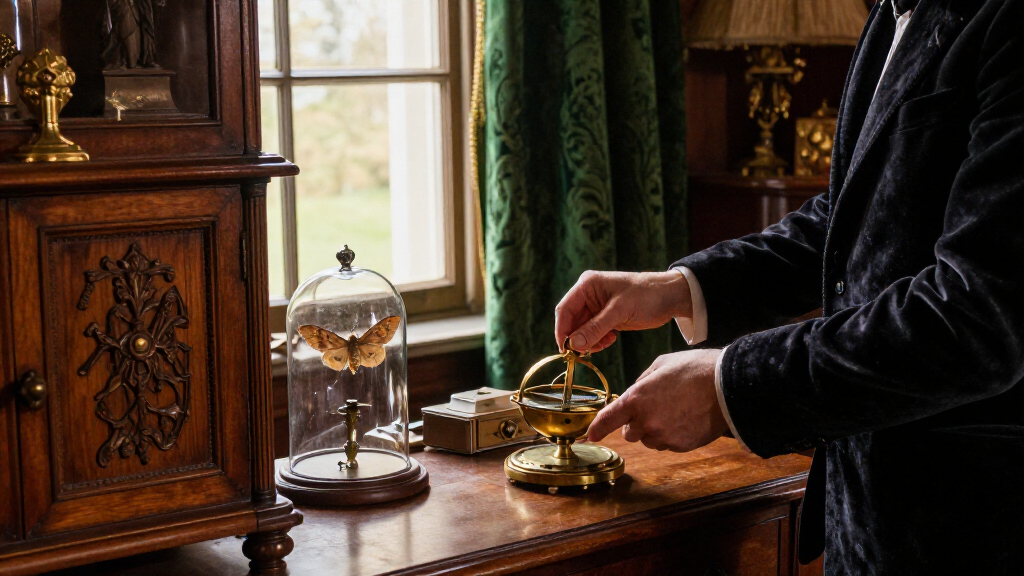
Consider a narrow shelf where a model moth under glass sits beside a mineral and a small label. The arrangement nods to the careful display of a teaching collection, while the replica keeps its origin clear. If you choose a vintage specimen, ask what documentation comes with it and whether its materials need special care. Rules for wildlife products can differ by location, so verify local requirements before purchasing [2].
There is a practical design question, too: will the object fit the room’s scale and palette? A large mounted specimen may overwhelm a compact cabinet, while a small model can become a focal point when given a dark backing and a little space. A replica can be the better choice if dust, fading, or fragile materials would make the real object difficult to maintain.
Keep labels factual. “Replica moth model” or “vintage specimen, provenance documented” tells visitors what they are seeing without inventing a collection history. That small act of accuracy supports the cabinet’s scholarly mood. The goal is curiosity—an invitation to look closely—not a claim that every object carries a dramatic past.
Arrange the shelves so the cabinet feels collected, not crowded
A cabinet feels cohesive when you group objects by a simple theme, vary their heights, and leave open space around the pieces you want people to notice. Dark wood, glass doors, small compartments, restrained labels, and warm focused lighting can set the mood, but the arrangement does most of the work. Start with a few objects and edit as you go.
- Choose one theme for each shelf. Pair a shell and mineral for a nature shelf, or a globe and compass for an exploration shelf.
- Place the largest piece first. Give it a back corner or a small riser, then add shorter objects in front without hiding it.
- Group small finds in a tray. Keys, coins, and seals look intentional when they have a clear boundary.
- Leave breathing room. Keep a little empty space around the focal object so its shape reads at a glance.
- Check the light and labels. Use warm, indirect light and short, accurate labels; avoid direct sun on paper, textiles, and organic specimens [2].
For a real-world example, take a cabinet with three shelves. Put a brass compass and folded map together at the top, a fossil replica and mineral in the middle, and a facsimile botanical print with a pressed fern below. The repeated dark green and brass tones tie the levels together, while the different textures keep them from looking like matching props.
Then step back from the cabinet. If your eye jumps from object to object without resting, remove one piece or give the focal point more space. A cabinet is a display, but it is also a small room for the eye to wander. The quiet gaps matter as much as the objects.
Protect paper, plants, and delicate finishes from fading
Delicate cabinet objects last longer when you protect them from direct sunlight, humidity swings, dust, and excessive handling. Paper, textiles, and organic specimens can be especially vulnerable, so display them away from bright windows and use a cabinet or protective frame where appropriate [2]. Warm light can bring out brass and glass, but keep it indirect and avoid placing a heat source close to sensitive materials.
Suppose a botanical print hangs on the cabinet’s back panel. A sunny afternoon may make the ink glow, but repeated exposure can fade the paper over time. Moving the cabinet to a shaded wall, or using a facsimile for the display while keeping an original stored safely, lets you enjoy the composition without asking the original to do all the work.
Dust also changes how a display reads. A thin film on glass softens the whole cabinet, while dust on a fragile specimen can tempt you to handle it more often. Clean the cabinet’s exterior and shelves gently, and follow suitable conservation guidance for valuable or fragile objects rather than using an all-purpose cleaner on everything. Different materials have different needs; a brass instrument, old paper, and a pressed leaf should not receive the same treatment.
Keep frequently handled objects near the front only if they can withstand regular contact. Put delicate pieces farther back or behind glass, and place stable replicas where visitors can get a closer look. That arrangement makes the cabinet easier to enjoy day to day. A little planning preserves the crisp edge of a pressed leaf and the soft gleam of a brass compass for many seasons.
Build the best curiosity cabinet with honest finds
The best curiosity cabinet is a personal collection of objects that reward attention, not a contest to own the rarest antiques. Reproductions, found natural objects, family keepsakes, and contemporary crafts can sit together when they share a palette or idea and when you describe them honestly. The age of an object matters less to a home display than its shape, texture, and connection to the other pieces.
Picture a first-time collector working with a modest cabinet: a family key, a contemporary ceramic skull, a fossil replica, and a facsimile map. None needs a grand backstory. The key may belong to a relative, the skull may be a recent craft purchase, and the map may be a reproduction. Together they can still tell a story about memory, time, and exploration.
That approach also makes collecting more accessible. You can look at antique shops, estate sales, bookshops, museum reproduction collections, or contemporary makers, then check documentation for objects made from regulated materials [2]. A handmade paper moth or a carved wooden mineral can evoke the cabinet’s sense of discovery without requiring a rare specimen. If an item’s history is unknown, say so on the label—or leave the label off.
As you build the display, let the collection change. Rotate a few pieces with the seasons, replace a faded print with a fresh facsimile, or bring a new shell into the nature group. The cabinet stays alive when each object earns its place. The most memorable piece might be the one you found on a walk, not the one with the oldest date.
Frequently Asked Questions
What is a curiosity cabinet?
A curiosity cabinet, or cabinet of curiosities, is a collection of unusual natural, scientific, historical, and artistic objects arranged to invite wonder and close inspection. European examples were popular from the Renaissance through the 18th century [1].
What objects belong in a Gothic curiosity cabinet?
Try shells, minerals, fossils, old books, maps, brass instruments, keys, and hourglasses. Choose a few that share a color or theme, such as exploration or natural history, and leave enough space to see their shapes clearly.
Do curiosity cabinet objects need to be antique?
No. Reproductions, family keepsakes, and contemporary crafts can create a convincing display when they connect visually or thematically. Describe each piece honestly rather than inventing an age or history.
How can I make a curiosity cabinet look Gothic without clutter?
Use dark wood, a limited palette, a few focal pieces, and contained groups for small objects. Vary heights and leave open space around striking shapes; a shelf with five well-placed objects often reads more clearly than one packed full.
Are bones, taxidermy, and human remains suitable for a cabinet?
They can suggest a natural-history or memento mori display, but provenance, ethics, conservation, and local rules matter. When origin or documentation is unclear, choose a replica, symbolic motif, or non-animal alternative.
How do I protect delicate cabinet objects?
Keep paper, textiles, and organic specimens away from direct sunlight, humidity swings, dust, and excessive handling [2]. A glass-fronted cabinet and warm, indirect light can help, but follow appropriate conservation guidance for fragile or valuable pieces.
Conclusion
Build your cabinet around a few objects that invite a closer look: a fossil beside a map, a compass beside a dark-bound book, or an hourglass beside a pressed leaf. Give each piece room, label it honestly, and protect fragile materials from harsh light. Reproductions and contemporary crafts can carry the same sense of wonder as antiques when you choose them with care.
Start with one shelf and one small story. Let the rest of the cabinet gather slowly, like a study lit by the last warm glow of evening.