
TL;DR
Mestiz and Powerhouse Arts have created Twenty Petal Flower, a seven-tier public altar in Manhattan’s Flatiron North Plaza, commissioned by the Flatiron NoMad Partnership. The woven installation is open to visitors through Nov. 3, 2026, and invites them to leave remembrances while honoring the people involved in bringing cempasúchil flowers to Día de Muertos traditions.
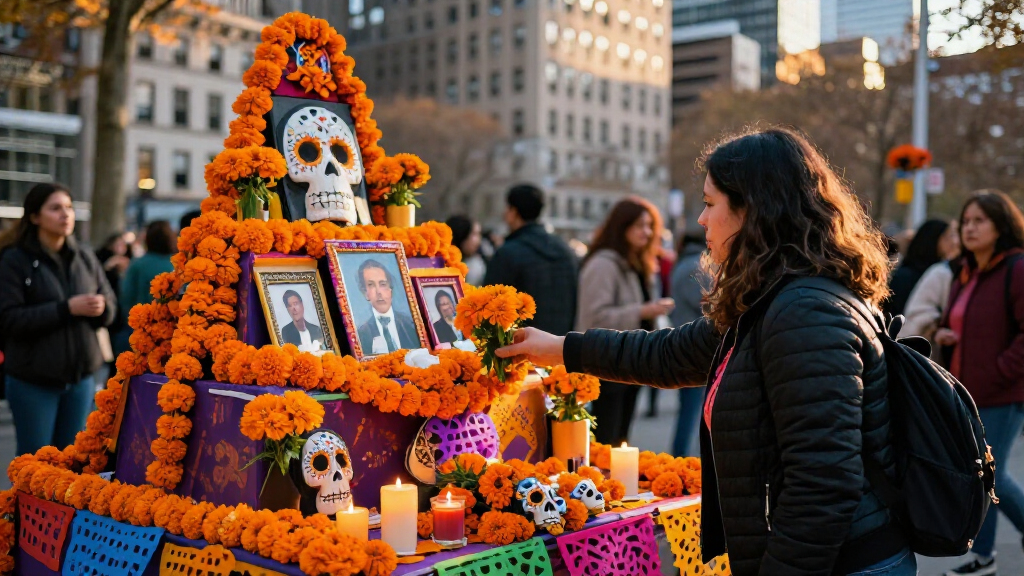
Mestiz and Brooklyn-based Powerhouse Arts have installed Twenty Petal Flower, a seven-tier public altar in Flatiron North Plaza in Manhattan, for Día de Muertos. Commissioned by the Flatiron NoMad Partnership, the installation is on view through Nov. 3, 2026, and invites visitors to leave mementos honoring people who have died.
Designed by artist and Mestiz founder Daniel Valero, the structure reimagines an ofrenda, or traditional altar, as an open public gathering place. Its name refers to cempōhualxōchitl, a Nahuatl term meaning “20-petal flower,” from which the Spanish name cempasúchil, or marigold, is derived. In Día de Muertos tradition, the flowers are associated with guiding the spirits of loved ones home.
The oversized floral forms were made primarily from wicker using traditional weaving techniques at Mestiz’s fiber workshop in Tequisquiapan, Mexico. Their rounded orange petals are arranged over seven tiers and lit with warm, candle-like lighting. The design follows the flower’s journey from fields in Michoacán, Mexico, to the artisans who turn it into the arrangements associated with the holiday.
Powerhouse Arts developed a supporting steel framework for the outdoor plaza, working with Mestiz on samples, textures and color matching. The flowers are attached with stainless-steel ties, according to Brittni Collins, the organization’s director of public art. Collins said the frame was kept slim and painted to match the orange flowers so it would not dominate the woven forms. The support system is modular and can be disassembled, stored and installed again for future celebrations.
A Public Place for Remembrance
The installation brings an ofrenda into a busy public plaza, making space for remembrance beyond a private home or community setting. Visitors can approach the altar, spend time with it and leave their own mementos. That invitation gives the work a participatory role: people passing through the neighborhood can contribute personal memories rather than only view the structure.
Valero said the project also seeks to recognize the people behind the flowers—from those who grow cempasúchil to the makers who shape it into an ofrenda. That focus broadens the work’s subject from remembering loved ones to acknowledging the labor and craft that help sustain the tradition. The commissioning partnership describes the plaza as a setting where the installation can interrupt the neighborhood’s everyday movement and prompt visitors to learn about the stories behind it.
For New York’s Mexican community, Valero said, the work may offer a piece of home, while introducing other visitors to the meaning of Día de Muertos. That is the artist’s stated aim; the organizers have not reported visitor numbers or measured public response.
Popular right now

Samsung 75-Inch M80H Series Mini LED 4K Smart TV (2026)

Dreame G10 Pro Wet and Dry Vacuum Mop

Dyson Car+Boat Cordless Handheld Vacuum
As an affiliate, we earn on qualifying purchases.
From Mexican Workshop to Manhattan Plaza
The project links Mestiz’s fiber workshop in Tequisquiapan with fabrication work in Brooklyn. The woven components were produced in Mexico, while Powerhouse Arts helped engineer a structure suited to an outdoor installation. The collaboration required the teams to exchange images and samples as they worked to preserve Valero’s design while addressing the practical demands of a public plaza.
The partnership’s president, James Mettham, said the open scale of Flatiron North Plaza made it possible to create an immersive work within the neighborhood’s ordinary routine. Valero described his design challenge as making a delicate, temporary flower feel architectural without losing its handmade character. The resulting installation uses woven wicker forms and a largely concealed frame to combine craft and structural support.
The altar is not described as a single-use structure. Collins said its modular construction is intended to allow it to be stored and reinstalled for future celebrations. The report does not identify any specific future venue or installation date.
““This time, I wanted to honor the many hands behind the cempasúchil, from the people who grow it to those who transform it into an ofrenda.””
— Daniel Valero, artist and Mestiz founder
Visitor Response and Future Installations
The installation’s public reception, visitor totals and any measured effect on activity in the plaza have not been reported. The stated goals of encouraging remembrance and cultural exchange come from the artist and commissioning partnership; the available report does not include independent audience research.
Although the modular structure is designed for future reuse, no later installation, storage plan or schedule has been announced. The report also does not give dimensions, production costs or details about how long individual visitor offerings will remain in place.
Altar Remains Through November 3
Twenty Petal Flower is scheduled to remain in Flatiron North Plaza through Nov. 3, 2026. During that period, visitors are invited to approach the altar and leave mementos in remembrance of loved ones. The available information does not specify any related public programs or a separate closing event.
After the viewing period, the modular structure can be disassembled and stored, Collins said, though the team has not announced when or where it may be shown again. Any future presentation would depend on further plans from the project partners.
Key Questions
Where can visitors see the altar?
Twenty Petal Flower is installed in Flatiron North Plaza in New York City’s Flatiron District.
How long will the installation be on view?
The altar is scheduled to remain on view through Nov. 3, 2026.
Who created and commissioned the work?
Artist and designer Daniel Valero created it through his studio, Mestiz, in collaboration with Brooklyn-based Powerhouse Arts. The Flatiron NoMad Partnership commissioned the installation.
Can visitors leave something at the altar?
Yes. The installation is presented as a public ofrenda, and visitors are invited to leave mementos honoring loved ones who have died. The report does not specify rules for the size or type of offerings.
Will the altar be displayed again?
The support system was designed to be disassembled, stored and reinstalled, according to Powerhouse Arts’ Brittni Collins. No future location or date has been announced.
Source: design-milk.com