TL;DR
A curiosity cabinet, also called a cabinet of curiosities or Wunderkammer, is a display of intriguing objects arranged to spark questions and tell a story. To build one at home, choose a theme, begin with a few objects you own or can source ethically, arrange them around a focal piece, add honest labels, and protect them from sun, heat, damp, and rough handling.
A curiosity cabinet can begin with one ordinary shelf. Add a weathered stone, a family photograph, and a small brass object, and suddenly the corner has a story. The appeal comes from the connections you make between pieces—not from owning rare artifacts or filling every inch of glass.
A curiosity cabinet, also called a cabinet of curiosities or Wunderkammer, is a display of intriguing objects. Historic collections often brought together natural specimens, artworks, instruments, and artifacts; your home version can be smaller, looser, and far more personal. You’ll learn how to choose a theme, find objects responsibly, arrange them so each one can be seen, and keep delicate pieces safe. Think of the display as a little stage: each object gets a part, and empty space gives the story room to breathe.
You don’t need an antique case or a collector’s budget. A shallow bookcase, shadow box, or tray can work. For instance, a windowsill shelf might gather local stones, a printed map, and a note about where you found each rock. Start with what interests you, then build a display that rewards a second look.
Choose a loose theme that connects the objects and gives visitors a way into the display.
Begin with a shelf, tray, or shadow box and a small group of pieces you already own or can source responsibly.
Check local rules and provenance before collecting natural or cultural objects; photograph a find when taking it would be inappropriate.
Arrange around one focal piece, vary shapes and heights, and leave open space so each object can be seen.
Label what you know, mark uncertainty honestly, and keep fragile objects away from sun, heat, damp, and rough handling.
How to Build a Curiosity Cabinet at Home
A cabinet of curiosities, or Wunderkammer, is a display of intriguing objects arranged to spark questions and tell a story. Start with a theme, a few meaningful pieces, and the space you already have.
Build a story, not a pile
A loose theme gives the display a thread for visitors to follow—and gives you a useful test for what belongs.
Key insight: A curiosity cabinet does not require a cabinet. A shelf, shallow bookcase, shadow box, or tabletop tray can hold a focused display using objects and space you already have.
Choose a thread
Try local geology, botanical prints, family memory, vintage tools, or objects in one color. “Things I noticed on my commute” is a theme, too.
Ask what connects
A stone, a map, and a note about one walking path can tell a place-based story even when the objects differ in shape and material.
Let it evolve
Use the theme to guide additions and avoid impulse buying. If the story stops feeling alive, revise it; changing the story is part of collecting.
Set the first scene
Keep the setup small and easy to adjust. Gather from home before buying anything.
Pick a spot
Check depth, strength, stability, and distance from heaters or damp areas.
Name the story
Write a short phrase such as “local stones and old maps.”
Gather a few
Choose things you own, made, inherited, or sourced transparently.
Place the focal piece
Give the largest or most meaningful object a clear position.
Add and adjust
Arrange companions, add honest notes, and live with the display.
The 3–7 piece range is a useful starting point, not a rule. A tray can rotate seasonally; a shadow box can protect flat or fragile pieces.
Arrange for a second look
Contrast, height, and breathing room guide the eye. An empty patch of shelf is a pause in the story.
Start with the largest or most meaningful object, slightly off center. Place smaller companions in loose groups by color, material, shape, or subject. Odd-numbered clusters can be a pleasing starting point, but they are not a rule.
Pair tall with low, smooth with rough, or natural with handmade. Step back: if a print disappears behind a taller object, move it forward or frame it. Make sure every piece can be seen.
Keep the story honest
Curiosity is a reason to learn about an object, not a reason to remove it from a place or community.
Clear origins
Use inherited keepsakes, your own craftwork, reproductions, contemporary work from makers, and objects with transparent provenance. A family button or a pebble you already own can carry meaning without rarity.
Unclear or protected finds
Check local rules before collecting plants, fossils, shells, or other specimens. Avoid protected wildlife and archaeological material of uncertain provenance. If taking a find is inappropriate, photograph it in place.
Label what you know
Record what an item is, where it came from, and why it matters. If a stone may be volcanic but you have not confirmed it, write “possibly volcanic” or simply note the location. Honest uncertainty turns a label into a question worth exploring.
Keep delicate pieces safe
Good placement helps objects last and keeps your display easy to enjoy.
A quick placement check
Secure the setup
Use a stable shelf and secure heavy objects. Keep light-sensitive and moisture-sensitive pieces away from direct sun and damp. Handle fragile items as little as possible; follow appropriate hygiene and handling guidance when displaying specimens.
From curiosity to a living display
Choose a theme that gives your objects a shared story
A theme makes a curiosity cabinet feel like a collection rather than a storage shelf. Pick a thread that connects your objects—local geology, botanical illustrations, family keepsakes, shells from a reputable source, or even pieces in the same color. The theme can stay loose; it only needs to give you a reason to put these things together.
Try asking what you want someone to notice. A collection of objects from your neighborhood might show how its landscape changes from river to pavement. A cabinet of old keys, handwritten notes, and a photograph might explore family memory. For instance, you could pair a stone from a favorite walking path with a postcard of the same place and a small sketch you made there. The objects differ, but the shared setting gives them a quiet link.
Let the theme guide your next addition. If your display centers on coastal forms, a driftwood shape or a drawn map may fit better than a random souvenir. That simple test helps prevent impulse purchases from taking over. A theme also gives visitors an easy entry point: they can follow the connection you chose, then make their own.
You don’t need a grand concept. “Things I found on the way to work” is enough if it makes you curious. The cabinet should invite exploration, not enforce museum rules. If the theme stops feeling alive, revise it; changing the story is part of collecting.
Popular right now

Vitamix Propel Series 510 Professional-Grade Blender, 3 Programs, Black

Ninja CREAMi 7-in-1 Ice Cream Maker, NC301

Bose QuietComfort Wireless Noise-Cancelling Headphones, Petal Pink
As an affiliate, we earn on qualifying purchases.
Start with a shelf and a small group of meaningful pieces
To build a curiosity cabinet, choose a space and gather a few objects before buying anything. A cabinet is a display, not a required piece of furniture: a tray on a desk, a shallow bookcase, or a glass-front shelf can all hold a collection. The right spot gives you enough room to see the pieces and enough stability to keep them secure.
- Pick the space. Check the shelf’s depth, strength, light, and distance from heaters or damp areas.
- Choose a story. Write a short phrase such as “local stones and old maps.”
- Gather three to seven pieces. Use items you own, make, inherited, or acquired from a transparent, reputable source.
- Place the focal object first. Give the largest or most meaningful piece a clear position.
- Add companions and a note. Arrange the rest, label what you know, then live with the display for a few days.
That range is a starting point, not a rule. Imagine a narrow shelf with a palm-sized stone, a small print, and a brass compass inherited from a relative. Each piece has room to show its texture and shape. If you add six more objects immediately, the stone’s rough edge and the print’s fine lines may disappear into visual noise.
Leave room to change your mind. A rotating tray works well if you like seasonal displays, while a shadow box can protect flat or fragile pieces. The best first setup is the one you can adjust without turning the project into a renovation.
Source objects ethically and keep their stories honest
Choose objects you own, make, or can acquire legally and ethically. Curiosity is a reason to learn about an object, not a reason to remove it from a place or a community. Natural specimens can raise questions about wildlife protections and conservation, while cultural objects may have histories of displacement or contested ownership. When an object’s origin is unclear, leave it out until you know more.
Good starting points include inherited keepsakes, your own craftwork, reproductions, contemporary work from makers, and objects with transparent provenance. For example, a small print bought directly from a local artist has a clearer story than an artifact with no explanation of where it came from. A family button or a pebble you already own can also carry meaning without adding pressure to collect something rare.
Check local rules before collecting plants, fossils, shells, or other specimens. Regulations vary by location and by species, and a familiar beach or trail is not automatic permission to take something. When in doubt, photograph the object where you saw it, then research it later. That image can preserve the memory without disturbing the site.
Keep the label as careful as the sourcing. If you think a stone may be volcanic but haven’t confirmed it, say “possibly volcanic” or simply record where you found it. A neat, confident label can make a guess look like a fact. Honest uncertainty is part of a good collection: it gives you a question to investigate instead of a claim to defend.
Arrange the display so every object gets noticed
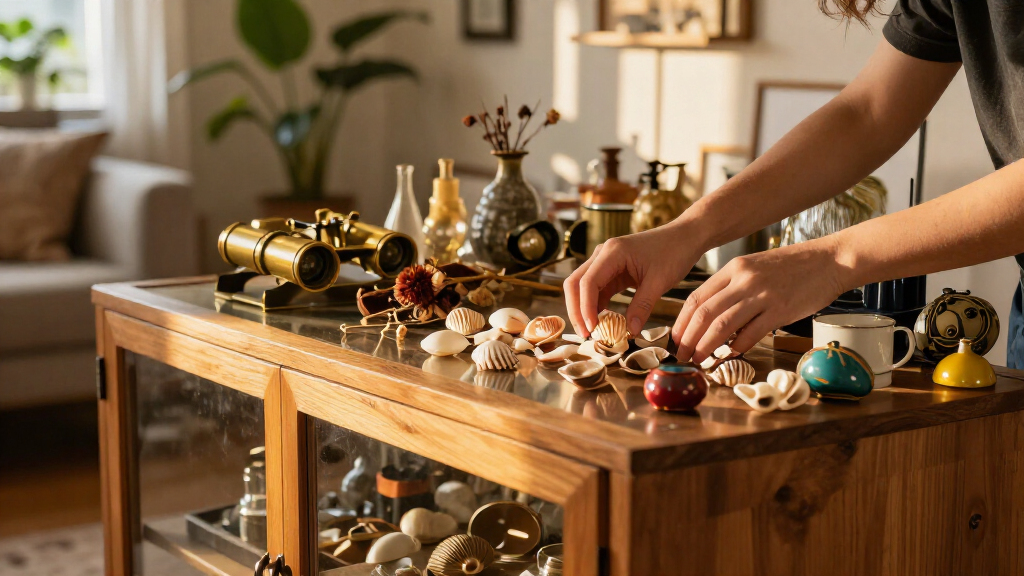
Arrange a curiosity cabinet around one focal object, then use contrast and open space to guide the eye. Try pairing a tall item with a low one, a smooth surface with a rough one, or a natural object with a handmade piece. The differences make each object easier to see; a display where everything has the same height and texture can feel flat.
Start by placing your largest or most meaningful piece slightly off center. Add smaller objects nearby in loose groups, perhaps by color, material, or subject. Odd-numbered clusters can make a pleasing starting point, but they are not a requirement. For instance, a round stone might anchor a group of three: a small map, a dark glass bottle, and a handwritten note about the river path where the stone came from.
Give objects breathing room. An empty patch of shelf is not wasted space; it acts like silence between lines of a story. If a delicate print sits behind a taller object, move it forward or put it in a small frame. Step back and check whether you can identify each piece without leaning close or lifting another object out of the way.
Take a phone photo once you like the arrangement. You can compare it after adding new finds and notice when the shelf starts to feel crowded. If one object no longer has room to register, rotate it into storage and bring it back for another display later. A thoughtful cabinet changes over time.
Add short labels that deepen the mystery without inventing facts
A good label tells you what an object is, where it came from if known, and why you kept it. A few words can turn a curious shape into a story without covering the shelf in text. Use a small card, a handwritten note, or a collection journal tucked nearby. Digital photographs or QR-linked notes can hold longer details while the display stays visually quiet.
For instance, a label for a stone might read: “River stone, collected on my walk near home, spring 2024; I like the pale stripe across its middle.” That records a location and personal meaning without pretending to identify the mineral. If you don’t know the date or origin, mark it as unknown rather than filling in a plausible-sounding answer.
Separate observation from interpretation. “Brass key, inherited from my aunt” describes what you know; “key to the old family house” is a stronger claim unless you have evidence. You can still include the question: “I wonder what this opened.” That small distinction makes your display more trustworthy and often more intriguing.
Labels also help future you remember why a piece mattered. If a visitor asks about the small, scratched object in the corner, a note can preserve the memory of finding it in a box of postcards. Keep the writing brief enough to read at a glance. The object should remain the main event.
Protect fragile pieces from light, damp, heat, and handling
Protect a curiosity cabinet by keeping vulnerable objects away from direct sun, heat, damp, and frequent handling. Paper, textiles, photographs, and some natural materials can be sensitive to their surroundings. A bright window may seem like the perfect place for a display, but several hours of direct light can fade colors over time. A shelf above a radiator or beside a steamy bathroom also brings avoidable heat or moisture.
Choose stable supports and make sure shelves can bear the weight of heavier pieces. Put heavy objects low and secure them so a small bump will not send them sliding. For example, a glass bottle or stone may feel solid in your hand, yet a narrow shelf near a doorway can make it easy to knock over. A case can reduce dust and casual handling when that suits the object.
Match care to the material. A postcard may need a protective sleeve and a place out of sunlight; a metal object may need a dry spot; a fragile specimen may need appropriate hygiene and handling guidance. Avoid cleaning an unfamiliar or valuable piece by guesswork. For an especially vulnerable or valuable object, consult a conservator for suitable care advice.
Put a quick check on your seasonal routine: look for signs of damp, dust, loose supports, or fading. If you rotate pieces, keep the stored objects somewhere stable and dry, and note where they belong. Care does not need to look dramatic. Quiet, steady attention helps preserve the cabinet’s stories.
Frequently Asked Questions
What is a curiosity cabinet?
A curiosity cabinet, also called a cabinet of curiosities or Wunderkammer, is a display of intriguing objects arranged to spark questions and tell a story. At home, it might bring together keepsakes, art, natural finds, or small handmade objects around a loose theme.
Do I need an antique cabinet to make one?
No. A shelf, shallow bookcase, shadow box, or tabletop tray can work. Choose a spot that gives the objects room and keeps them stable; a small shelf with three meaningful pieces can feel more intentional than a large crowded case.
How many objects should I display?
There is no fixed number. Start with a few pieces and add only when each one still has room to be seen. If a new object hides a label or makes the arrangement feel crowded, rotate something out rather than squeezing everything in.
Can I include shells, fossils, plants, or other natural specimens?
You can include natural specimens when you have acquired them legally and ethically and can store them safely. Rules vary by location and species, so check before collecting; when unsure, take a photograph where you found an object and research it later.
How do I make my cabinet look organized instead of cluttered?
Use a theme or a repeating visual detail, then arrange around one focal object. Vary heights and textures, group related pieces, and leave open space. A small collection of stones, a map, and a handwritten field note can look coherent because the shared place links them.
What should I write on object labels?
Keep labels short: include an object name, its source or date if known, and a sentence about why you included it. Mark guesses as uncertain instead of presenting them as facts; “possibly volcanic stone” is more honest than an unverified identification.
How do I keep delicate objects safe?
Keep fragile or light-sensitive pieces away from direct sunlight, heat, damp, and frequent handling. Use stable shelves and suitable supports, and consider a case when it helps protect the object. For valuable or vulnerable pieces, ask a conservator about care.
Does a curiosity cabinet have to cost a lot?
No. You can begin with a shelf or box you already own and objects from home, such as family keepsakes, your own artwork, or items you have acquired responsibly. Costs rise if you choose specialized display cases or conservation materials, but neither is required for a small personal collection.
Conclusion
Build your curiosity cabinet around the objects and stories you can care for well. Choose a theme, start with a few pieces, and let honest labels and open space help each one speak. You can make a compelling display on an ordinary shelf, then change it as your interests shift.
Keep the first version small enough to notice every detail: the chipped edge, the faded ink, the pale stripe in a stone. A cabinet should leave you with a question worth returning to.