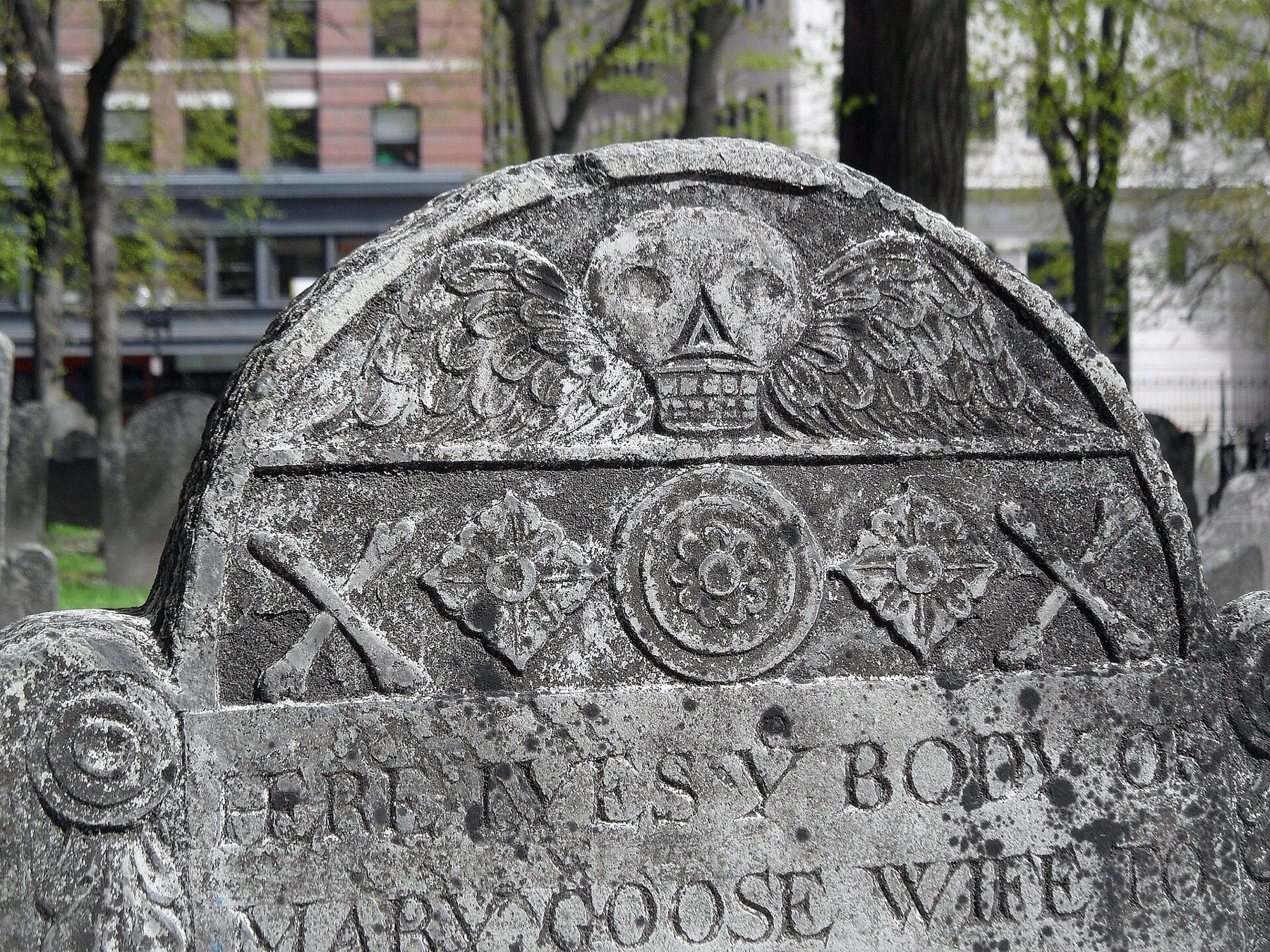

Walk through an old burial ground in Boston and the stones seem to speak in a code: winged skulls, hourglasses, crossed bones, then smiling winged faces, and later urns under weeping willows. In the 1960s two archaeologists, Edwin Dethlefsen and James Deetz, did something simple and influential with that code. They counted it.
Their study turned New England gravestones into one of archaeology’s classic examples of how styles rise and fall over time. It also shows the limits of the symbol dictionaries that circulate online, which promise a single meaning for every carving.
At a glance
- The sequence: in colonial New England, the winged skull (“death’s head”) gave way to the winged face (“cherub”), which gave way to the urn and willow.
- Timing: roughly from the late 17th to the early 19th century, with local differences.
- The study: Dethlefsen and Deetz used dated gravestones to test how archaeologists date changing styles (1966).
- Caution: the Association for Gravestone Studies warns that interpretations are “possibilities, not certainties”.
Death’s head, cherub, urn and willow
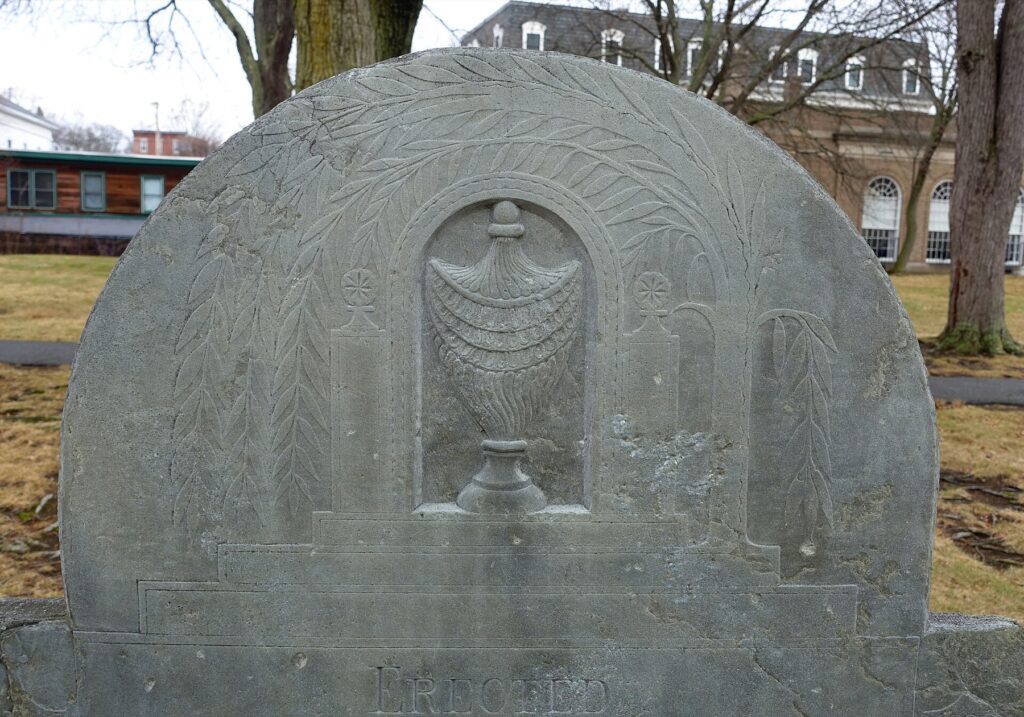
Gravestones are unusual archaeological objects: most carry a date. Dethlefsen and Deetz used that to follow three main designs on stones in eastern Massachusetts. The earliest common motif was the winged skull, a stark reminder of death and decay. Over the 18th century it was gradually replaced by a winged human face, often called a cherub or soul effigy, which stressed the soul rising rather than the body decaying. Around the end of the 18th century both gave way to the urn and willow, a neoclassical design of mourning and memory.
Plotted over time, each design rises, peaks and declines in a long curve, overlapping with the next, which is exactly the pattern archaeologists assume when they date undated finds by style. The authors linked the changes to religious and cultural shifts in New England, from strict Puritan doctrine towards a gentler, more sentimental view of death.
Reading the symbols
Some carvings do carry fairly clear meanings. Writing for the Association for Gravestone Studies, Jessie Lie Farber notes that a winged hourglass says that time flies, an hourglass on its side that time has stopped for the dead person, and a broken flower or tree that a life was cut short. A hand pointing downward can stand for mortality or sudden death, one pointing upward for the reward of the righteous. Clasped hands may be a farewell, or a couple to be reunited.
Other symbols belong to organisations rather than to theology. The sawn-off tree stump, often with an axe, mallet and wedge, is the emblem of the Woodmen of the World, a fraternal benefit society, with the motto Dum tacet clamat, “though silent, he speaks”. The letters FLT inside three chain links mark a member of the Odd Fellows: friendship, love and truth.
Why symbol dictionaries mislead
The same guide is blunt about the limits. Not all designs can be interpreted in a neat, uncomplicated way, Farber writes; professional scholars disagree sharply about particular designs, and interpretations “must be used as possibilities, not certainties”. Carvers copied pattern books and each other, families chose what was available and affordable, and a motif could be fashionable without carrying a deep message. The best evidence is always the stone itself: its date, its inscription and its neighbours.
Documented / Disputed
Documented
- In eastern Massachusetts, death’s head, cherub and urn-and-willow designs followed each other in overlapping waves from the late 17th to the early 19th century (Dethlefsen and Deetz 1966).
- A winged hourglass signifies that time flies; a broken flower or tree a life cut short (Association for Gravestone Studies).
- The tree-stump monument is the emblem of the Woodmen of the World; FLT stands for the Odd Fellows’ friendship, love and truth (Association for Gravestone Studies).
Disputed or often repeated
- Fixed meanings for every symbol. Scholars disagree; interpretations are possibilities, not certainties (Association for Gravestone Studies).
- “Skulls mean a pirate or a curse.” In colonial New England the winged skull was an ordinary Puritan reminder of mortality.
- “Obelisks are Masonic.” The Association for Gravestone Studies notes that Freemasonry was not responsible for the popularity of obelisks.
- Exact dates for each design. The changes overlapped and varied from town to town and carver to carver.
Timeline
- Late 17th century: The winged skull is the dominant gravestone design in eastern Massachusetts.
- 18th century: Winged faces, the “cherubs”, gradually replace the death’s head.
- Late 18th to early 19th century: Urn and willow designs take over.
- 1966: Dethlefsen and Deetz publish their study of the sequence in American Antiquity.
Sources
Primary sources
- Gravestones in the Granary Burying Ground, Boston, and Memorial Cemetery, Westborough (see image credits).
Secondary sources
- Edwin Dethlefsen and James Deetz, “Death’s Heads, Cherubs, and Willow Trees: Experimental Archaeology in Colonial Cemeteries”, American Antiquity 31, no. 4 (1966): 502–510. doi:10.2307/2694382.
- Jessie Lie Farber, “Symbolism in gravestones”, Association for Gravestone Studies. gravestonestudies.org.
Image credits
- Header image: Winged skull on a gravestone, Granary Burying Ground, Boston: Matthias Nonnenmacher, 2019. Licence: CC BY-SA 4.0, via Wikimedia Commons.
- In-text image: Urn and willow on a gravestone, Westborough, Massachusetts: Daderot, 2018. Licence: Public domain, via Wikimedia Commons.
Related
- Charnel Houses and Ossuaries: Where Europe Kept Its Bones
- Grave Goods and Burial Coins: Charon’s Obol to Sutton Hoo
Part of Death Customs in Dark History, Documented. How we research and how we use AI: Editorial Standards. Spotted an error? Tell us at contact@macabrechronicle.com; fixes are logged on the Corrections page.
Editor’s note: This article replaces two shorter pieces on tombstone and graveyard symbolism that first appeared in the Macabre Chronicle section of moleopedia.com. It was rewritten from the sources above and published here on 30 October 2026.
Evergreen bestsellers Picks

KitchenAid Artisan Series 5-Quart Tilt-Head Stand Mixer, Dried Rose (KSM150PS)

Bose QuietComfort True Wireless Earbuds with Active Noise Cancellation, Black

Dyson Ball Animal 3 Corded Upright Vacuum
As an affiliate, we earn on qualifying purchases.