
TL;DR
The best taxidermy-style replicas for a curiosity cabinet have convincing proportions, thoughtful surface detail, a pose that suits your space, and clearly described materials. Check dimensions, mounting, care instructions, and whether the listing shows the exact piece before you buy; then give the replica breathing room among books, fossils, and botanical objects.
“Taxidermy-style” describes an appearance, so ask what materials a replica uses if animal-free construction matters to you.
Judge craft through proportions, facial detail, markings, surface finish, pose, and clear close-up photographs.
Measure your shelf and confirm the object’s weight, dimensions, base, and mounting method before ordering.
Compare handmade and mass-produced pieces by their visible workmanship and fit, not by price or labels alone.
Dust gently, follow the maker’s care advice, and protect delicate finishes from moisture, heat, and prolonged direct sunlight.
Choose a replica that belongs in your cabinet
Materials, close-up detail, and scale matter more than a “faux taxidermy” label. Check how each piece is made and displayed before you buy.
Start with the materials
“Taxidermy-style” describes an appearance, not a standard material or production method.
Ask what it’s made from
Replicas may use resin, papier-mâché, wood, ceramic, or other materials. Confirm the materials and finish with the seller.
Read beyond the label
“Faux,” “replica,” and “taxidermy-inspired” can overlap. Verify the construction if non-animal materials matter to you.
Judge craft up close
A convincing piece brings its shape, surface, and pose together; decorative realism does not guarantee scientific accuracy.
See whether the pose and proportions feel balanced from a distance.
Look at eyes, markings, texture, paint, seams, and facial features in close-up photos.
Ask for close-ups or a different angle when the listing leaves important details unclear.
Make the scale work
Compare the full dimensions with your shelf and leave room for nearby objects and labels.
- Check height, width, depth, and weight.
- Confirm whether it stands alone or needs a wall mount or plinth.
- Consider whether its pose and viewing angle suit the cabinet.
- Give prominent pieces breathing room.
- Pair replicas with books, fossils, botanical prints, or labeled jars.
- Arrange for the details to be visible from where you’ll view them.
Compare the workmanship
Handmade work may have distinctive finishes and poses; mass-produced pieces are generally more accessible.
| What to compare | Handmade | Mass-produced |
|---|---|---|
| Finish and pose | May be more distinctive | Compare visible detail |
| Price and choice | Compare construction | Generally more accessible |
| How to decide | Judge the visible workmanship and fit, not labels or price alone. | |
Choose a replica by its materials, detail, and scale
The best taxidermy-style replicas for a curiosity cabinet are the ones whose materials are clear, details reward a closer look, and size fits your display. A replica can be sculpted from resin, papier-mâché, wood, ceramic, or another material; “taxidermy-style” names the look, not a shared recipe. Ask the maker what the piece is made from and how its finish is applied. Material affects more than appearance: it can determine whether an object feels heavy or delicate, how easily it chips, and which cleaning methods are safe. Replica does not automatically mean anatomically exact, either: some makers favor a striking decorative silhouette over scientific precision.[1]
Think about what you’ll notice from across the room and what you’ll see with your nose almost at the glass. A fox head may have a handsome russet coat, but uneven eyes or a bluntly painted nose can make it feel like a generic shop prop. Close-up photographs help you inspect proportions, eyes, surface texture, markings, and pose. Those details matter because they determine whether the object keeps its appeal after the first glance. A careful, small-scale piece can feel more convincing than a much larger model with hurried paintwork, even if the larger one is more dramatic from across the room.
Scale matters just as much as craft. Check the listed height, width, depth, and weight, then compare them with the shelf where the replica will live. A broad stag beetle model may overwhelm a narrow cabinet shelf, blocking labels or nearby objects; a palm-sized moth leaves room for those details but may be hard to see from a distance. Choose based on the viewing distance and the role you want the piece to play. Check whether it stands on its own or needs a wall mount or plinth; a mount can improve stability and viewing angle, but it also takes up space and may limit how easily you rearrange the cabinet.
Use a short checklist while comparing listings. Each answer narrows a different kind of uncertainty: what you are buying, what it will look like up close, and whether it can safely fit your intended spot.
- Read the materials description: identify the base material and surface finish, since these affect feel, durability, and care.
- Inspect close-ups: look at the eyes, edges, markings, and seams to judge finish beyond the hero image.
- Measure your space: compare all listed dimensions with the cabinet shelf, allowing room for nearby objects and labels.
- Confirm the display method: check weight, base, and mounting hardware so the piece can sit securely at the angle you want.
- Ask about unclear details: request additional photos if the listing leaves you guessing; an unanswered question is a real limit on your ability to assess the object.
For instance, if two raven replicas look equally dramatic in their hero shots, choose the one with a clear materials description, useful side-view photos, and dimensions you can actually work with. That may not be the most striking image online, but the extra information lowers the chance of a poor fit or a finish that disappoints in person. It is part of the object’s quality: it lets you judge whether the craft and construction suit your collection before the parcel arrives.
Popular right now

KitchenAid Classic Series 4.5-Quart Tilt-Head Stand Mixer, Onyx Black

Shark HydroVac MessMaster Corded Wet Dry Vacuum and Mop (WD161)

De'Longhi Magnifica Duo Fully Automatic Espresso Machine with Milk Frother, Silver
As an affiliate, we earn on qualifying purchases.
Look for lifelike detail without expecting scientific accuracy
Taxidermy-style replicas feel convincing when their shape, face, surface, and pose work together. Realism comes from more than a shiny eye or a realistic color. Look at the animal’s silhouette first: does a perched owl balance naturally, or does the pose seem stiff? Then inspect smaller details, such as the line of the beak, the edges around the eyes, and whether markings follow the form instead of sitting on top like flat decoration. The silhouette establishes the impression from a distance; the smaller details either reinforce that impression or make the piece feel inconsistent when you move closer.
Small details change how an object reads on a shelf. Imagine a rabbit replica beside an old natural-history book: softly blended paint and carefully shaped ears give it a quiet, collected look. Thick, uneven paint and a lopsided face may make the same shape feel more like a novelty. That doesn’t mean every collectible needs museum-grade finish. A stylized piece can suit a cabinet beautifully if you like its look and know what the maker intended. The tradeoff is that a highly stylized object may contribute more mood than natural-history resemblance, while a restrained finish can blend more easily with books and specimens.
Keep a distinction in mind: decorative realism is not the same as scientific accuracy. A replica can evoke a species without matching its anatomy precisely. If accuracy matters to you, compare the pose and markings with reliable natural-history references; if you’re choosing chiefly for atmosphere, focus on proportion, expression, and finish. This distinction helps set fair expectations: a convincing decorative object may still simplify anatomy, and a scientifically informed model may be less theatrical than the piece that first caught your eye. Either way, listing photos should let you see the details that matter to your decision.[1]
Consider a pair of beetle replicas in different finishes. One may have a glossy, jewel-like shell that catches the cabinet lamp, while another uses subdued, textured paint that feels closer to a field specimen. Neither finish is automatically better; the right one depends on the rest of your collection and the effect you want. Gloss adds contrast and draws attention, but can compete with reflective glass or brass nearby. A quieter surface may make a more cohesive display, though it can disappear in a dim cabinet. The glossy beetle might echo a brass magnifier and dark green velvet, while the quieter model could sit naturally beside labeled jars and botanical studies.
When a listing offers only one distant image, you cannot reliably judge face, markings, or surface. Ask for close-ups or a photo from another angle before committing. A maker who clearly describes a stylized pose or hand-painted finish gives you a more useful basis for comparison than a string of vague claims about realism. Your eye can do the rest: choose the piece whose details still hold your attention after the first glance, while being clear about whether you value atmosphere, accuracy, or a balance of both.
Check what the listing means by “faux” or “replica”
Taxidermy-style replicas may be made from non-animal materials, but words such as “faux,” “replica,” and “taxidermy-inspired” can overlap without identifying a specific construction. If you want a piece with no preserved animal remains, ask the seller to confirm the materials directly. The label alone may not settle the question, and a decorative model may use more than one material across its body, finish, mount, or base.[1] This is why a short, direct question is more useful than relying on a category or title: it turns a broad style claim into information you can actually use to decide.
That question is practical as well as ethical. Knowing the material can help you understand weight, fragility, and cleaning needs. A ceramic moth might have a delicate wing edge; a resin specimen could be sturdier but still have a vulnerable painted surface. If a listing says “handcrafted” but does not explain the construction, ask what the body is made from and whether any parts are natural or preserved. A clear answer can also help you plan where the piece belongs: a fragile edge may be unsuitable near a frequently opened cabinet door, even if the object otherwise fits the shelf.
For example, imagine buying a small fox head for an office shelf. The listing calls it “faux taxidermy,” but offers no material details. Before ordering, ask whether the head and mount use synthetic or other non-animal materials, what the finish is, and whether the photographed object is the exact one you’ll receive. A clear answer helps you decide whether the piece suits your preferences and whether it can handle the shelf you have in mind. If the seller cannot clarify a detail that matters to you, waiting or choosing a better-documented listing is less risky than trying to infer construction from a photograph.
Online photographs can hide important differences. A polished image may show a representative example rather than the exact handmade object; a close-up can reveal seams, brushwork, or a textured surface that the main photo conceals. Confirm the materials, dimensions, mounting method, shipping protection, and return terms in the listing or with the seller. These checks address different risks: materials and dimensions help you judge suitability, mounting affects safe display, and shipping and return details matter if a delicate object arrives damaged or differs from its photos. They are especially important when you cannot handle the piece before buying.
“Taxidermy-style” tells you what an object resembles; it doesn’t tell you how it was made. Ask for the construction details that matter to you, and keep the seller’s answer with your collection notes.
That note can be as simple as a card with the maker, material, date acquired, and care advice. Over time, those details give a curiosity cabinet a second layer: each object has not only a silhouette and a place, but a little record of how it came to be there. They also make future care easier, since you won’t have to guess whether a surface can tolerate a particular cleaning method.
Build a cabinet display that gives every specimen room
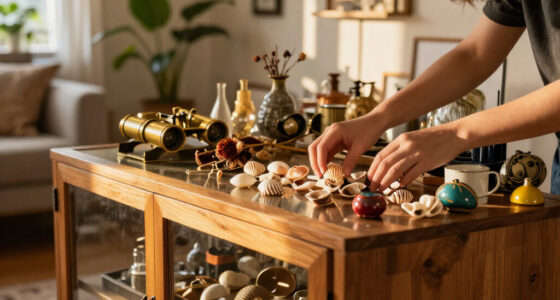
A strong curiosity-cabinet display groups objects by shape, color, or theme while leaving enough space for a focal piece to stand out. A shelf crammed edge to edge can make even a finely made replica disappear. Try varying heights: place a small specimen beside a low stack of natural-history books, then set a taller object farther back. The arrangement creates depth, like looking through several layers of an old collector’s study. It also changes what is easy to see: objects at different heights can reveal details that would be hidden in a single crowded line.
Taxidermy-style replicas sit naturally alongside fossils, botanical prints, labeled jars, and antique-style objects. You might pair a pale moth with a pressed-flower illustration and a dark-bound field guide, or put a beetle replica beside a fossil whose ridges echo its shell. These pairings give the eye a reason to travel between objects. A shared color or shape creates cohesion, while a difference in material—soft paper beside a glossy shell, for instance—keeps the grouping from becoming monotonous. They also let you build a personal story around the cabinet rather than filling it with unrelated pieces.
Here’s a practical test for a crowded shelf: remove everything, then put back the largest replica first. Add one or two objects that connect to it, and step back. If the display feels flat, change the height or position of a book; if it feels busy, remove one small object and leave a patch of visible shelf. Empty space is part of the composition. It gives a wing, horn, or painted eye a clean outline against the glass. That breathing room is especially valuable for a detailed piece: without it, the eye has little chance to register the features you chose the replica for.
Labels can add a natural-history note, but too many can make a cabinet feel like a shop display. Use short labels only where they add information, such as the replica’s material or maker. For a handmade beetle, a small card might say “painted resin” and name the maker. That gives visitors a useful detail without competing with the object itself. A label is most helpful when it answers a question a viewer might otherwise have; if it repeats what the display already communicates, it can become visual clutter.
Mixing materials gives the display texture: cool ceramic, matte paper, dark wood, and glass catch the light differently. Keep fragile pieces stable and position an object so the angle that drew you to it remains visible. A moth with delicate wings may look best on a secure stand at eye level, while a heavier wall piece needs a suitable mount. Stability and sightline work together: a piece that is safely placed but turned away from its most interesting detail may be secure, yet it won’t do its job as a focal object. These small choices let the cabinet feel intimate and collected, rather than staged all at once.
Compare handmade and mass-produced replicas by what you can see
Mass-produced replicas are often easier to find and may offer an accessible way to start a cabinet, while handmade work can bring more distinctive poses and finishes. Neither category guarantees a certain level of quality or a particular price. Compare the actual construction, visible detail, and seller information instead of treating price or a polished photograph as proof of craftsmanship. Online marketplaces carry both kinds, but a listing’s category cannot tell you whether one individual piece is well finished.[1] The useful question is not which production method is inherently better, but which qualities matter for your intended display and can be verified in that specific listing.
Use the comparison below to decide what matters for your shelf. Think of it like choosing between a neatly printed field guide and an annotated notebook: one may suit your purpose better, but you still want to inspect the particular copy. The same goes for a replica. A consistent finish can be exactly right for a matched pair, while small variations may be the charm of a handmade specimen. Those variations can also mean that the finished piece differs slightly from a listing photo, so ask what to expect if exact color or symmetry matters to your plan.
| What to compare | Mass-produced piece | Handmade piece |
|---|---|---|
| Appearance | May have a consistent finish across multiple copies | May show individual brushwork or small variations |
| Construction details | Check the listed material and finish | Ask how the maker built and finished the object |
| Photos | Confirm whether images show the exact item | Ask whether the photographed piece is the one for sale |
| Fit for your display | Compare dimensions, weight, and mounting | Check the same details, including any custom dimensions |
| Value to you | Consider the quality you can see and verify | Consider the distinct pose or finish you prefer |
Suppose you want two matching moths for opposite ends of a shelf. A consistent production finish might suit that plan. If you want one unusual centerpiece, a handmade piece with an expressive pose may feel more personal. In either case, inspect the same basics: proportions, paint, surface finish, size, mounting, and materials. A listing with clear photos and direct answers gives you more to work with than a high asking price or a dramatic backdrop. The tradeoff is practical: matching pieces may create order but less individuality, while an expressive one-off may draw the eye but be harder to pair with future additions.
Availability and styles change, and a broad trend toward animal-free decor doesn’t establish the quality or material of any specific item. Treat each listing as its own claim to check. The replica that suits you is the one whose craft you can see, whose construction you understand, and whose size and mood work in your cabinet.
Keep the finish looking good with gentle, simple care
Gentle dusting and the maker’s care instructions are the safest starting points for a taxidermy-style replica. Painted surfaces, glued details, and delicate features can respond poorly to moisture, heat, or direct sunlight. Use a soft brush or cloth to lift dust without rubbing hard, and avoid soaking the object or applying harsh cleaners unless the maker specifically recommends a method for that material and finish.[1] A gentle approach matters because a little dust is usually less damaging than a cleaning attempt that lifts paint, loosens a glued feature, or leaves moisture in a seam.
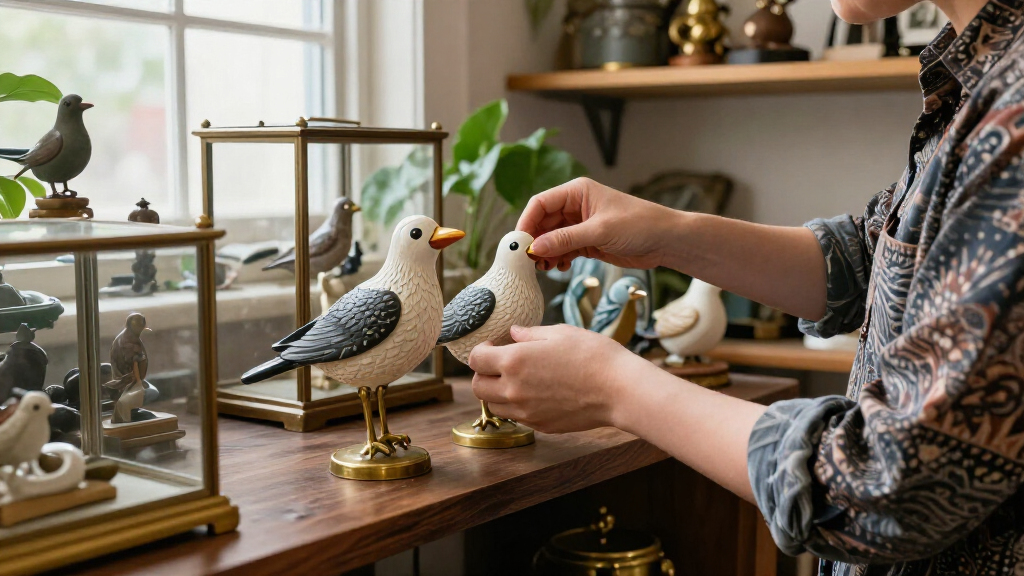
A small natural-bristle brush can reach into textured fur, feather-like sculpting, or grooves in a carved base. Work slowly and hold the piece securely, especially if it has thin legs, ears, or wings. Picture dusting a ceramic owl perched beside a lamp: rather than spraying the shelf, lift the owl carefully, dust its base and the shelf beneath it, then return it to a stable spot. That simple routine avoids leaving cleaner residue on a painted surface and reduces the chance of knocking the piece into another object.
Sunlight can also change a display. If a painted specimen sits in a bright window, the colors may be exposed to prolonged direct light; a cooler interior shelf can provide a steadier home. Keep replicas away from heaters, damp windowsills, and outdoor exposure unless the maker says the materials and finish can handle those conditions. Decorative replicas are commonly intended for indoor display, so check before giving one a place on a porch or garden shelf. Choosing a less dramatic but more stable location can preserve the finish and reduce the risk of temperature or moisture changes affecting different materials unevenly.
Care depends on the object. A wood base, glazed ceramic body, and painted resin surface do not all call for the same treatment. Save the maker’s instructions, and ask for guidance if the listing is silent about cleaning. A fragile or lightweight piece may also need protection from curious hands or pets; place it out of reach or secure its mount when the shape and setting call for it. In other words, use the least intervention that keeps the object clean and stable, rather than assuming one cleaning routine suits every replica.
For a cabinet you look at every day, a brief dusting every few weeks can be enough to keep surfaces clear, though the room and object determine the timing. Check the finish as you clean: if you notice loose parts, lifting paint, or a wobble, stop and ask the maker how to proceed. Continuing to dust a damaged surface can make a small problem worse. Your goal is to keep the details crisp—the soft painted markings, small glassy eye, or ridged shell that made the piece worth displaying in the first place.
Frequently Asked Questions
What is a taxidermy-style replica?
A taxidermy-style replica is a decorative object designed to resemble a mounted animal specimen, usually made without preserving the animal’s body. The phrase describes its appearance, not a standard material or method. Check the listing or ask the seller what the piece is made from.
Are these replicas always made without animal materials?
No label alone can confirm that. “Faux,” “replica,” and “taxidermy-inspired” can describe overlapping styles, so ask the seller directly whether the object and its components use preserved animal remains or other animal materials. Request details about the body, finish, and mount.
What makes a replica look realistic?
Proportions, pose, paint, texture, and facial detail all affect realism; the base material alone does not determine it. Look for close-ups of the eyes, markings, and surface, then decide whether you want decorative resemblance or closer anatomical accuracy.
How should I clean a taxidermy-style replica?
Start with a soft brush or cloth and follow the maker’s instructions. Avoid soaking, harsh cleaners, and prolonged direct sunlight unless the maker confirms the finish can tolerate them. A delicate painted wing or glued feature may need especially gentle handling.
What should I check before ordering a replica online?
Confirm the materials, dimensions, weight, mounting method, shipping protection, and return terms. Check whether the photos show the exact item or a representative example, and request another angle if a key detail is unclear. Measure the intended shelf before you buy.
How can I arrange replicas in a curiosity cabinet?
Start with your largest piece, then add a few objects that connect by color, shape, or subject. Vary heights with books or stands, use labels sparingly, and leave visible space around the focal specimen. A beetle beside a fossil or botanical print can create a clear visual link without crowding the shelf.