
TL;DR
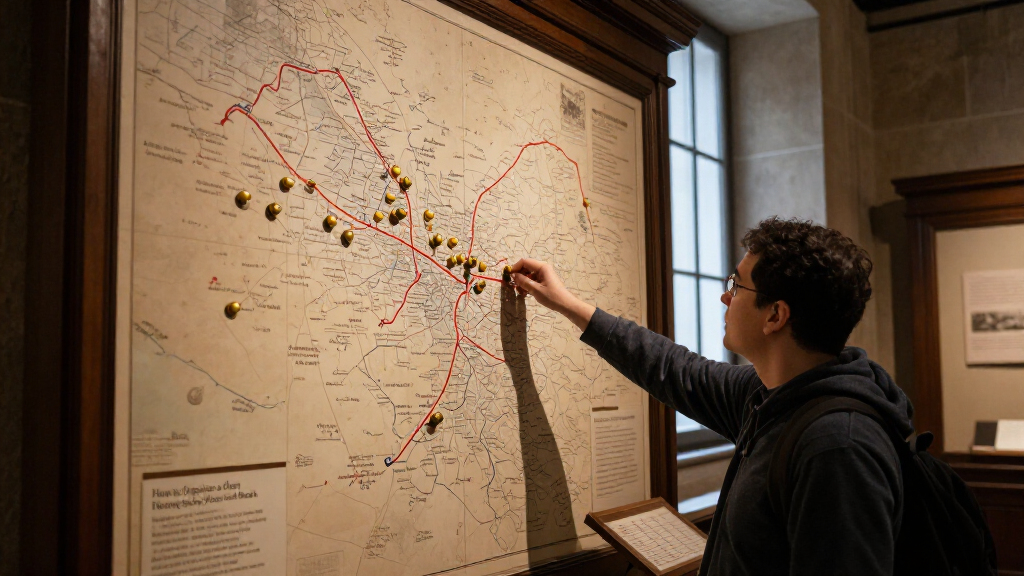
Organize a dark history reading list by region, then arrange books within each region by the historical period they cover. Give every entry a short note on its scope, perspective, evidence, and reading level, and use cross-references when events cross borders. Clear boundaries and concise content notes help readers follow difficult histories at their own pace.
A book about an empire published last year may begin centuries before a memoir published fifty years ago. If you sort both by publication date, the reading order can hide the history you want readers to follow. A list arranged by place and period gives each book a clearer place on the map and in time.
That structure works especially well for difficult histories: war, enslavement, colonialism, persecution, genocide, political repression, and state violence. The phrase dark history is a broad editorial label, not one single academic category. Your first job is to explain what your list covers, who it is for, and what it leaves out.
This guide shows you how to set those boundaries, order titles without pretending today’s borders always fit the past, and annotate books so readers know what kind of account they are picking up. Think of the finished list as a map with notes in the margins: it should show both the route and the terrain you cross.
Define the list’s scope, intended readers, and included formats before choosing titles.
Group books by a clearly explained place or region, then sort them by the historical period they cover.
Record publication date separately from the period covered.
Annotate each title with its perspective, evidence, scope, and assumed background knowledge.
Use cross-references and concise content notes to guide readers through connected and difficult histories.
Organize difficult histories by place and period
A clear route helps readers understand where events happened, when they happened, and how connected histories cross borders.
Set the list’s boundaries
Explain its purpose and who it is for before choosing titles.
Name the focus
Define the region, era, or theme—and what the list leaves out.
Mark entry points
Show which books suit newcomers and which assume background knowledge.
Label each kind
Distinguish surveys, memoirs, oral histories, primary sources, and fiction.
Build a route through place, then time
Use one geographic scale consistently, and order titles by the period they cover.
Use regions, countries, empires, or sites, and explain your labels.
Arrange books by the events or periods they cover.
Cross-reference books about migration, empire, trade, war, or diaspora.
Give every title useful context
Short annotations help readers choose a book and understand what kind of account it offers.
| Note | What readers learn |
|---|---|
| Place and period | Which history the book covers |
| Perspective and evidence | Whose account it centers and what sources it uses |
| Reading level | What background knowledge it assumes |
| Dates | Publication date, separate from the period covered |
Represent people and evidence with care
- Perspectives from communities discussed
- Different kinds of evidence and interpretation
- Survival, resistance, recovery, and memory
- Whose testimony is preserved or missing
- Where scholarly interpretations are contested
- Specific content notes for distressing material
Set boundaries so your list has a clear purpose
A useful dark history reading list starts by naming its scope, audience, and formats. Decide whether you are covering one region, a defined period, or a theme that crosses places, and say whether the list is for newcomers or readers with background knowledge. Those choices make the list easier to use and keep its promise honest.
For example, a list about colonial rule in the Caribbean could include historical surveys, memoirs, oral histories, and primary sources, but it should label each kind clearly. A beginner may want a broad overview before a focused study of one island or period. A specialist may prefer the reverse. Your list can serve both by marking suggested entry points rather than treating every title as equally accessible.
State whether you focus on what happened, how it happened, or its long aftermath. A list about a period of political repression could include books on state policy, personal testimony, resistance, and public memory. Those works answer different questions. A short scope note lets readers see why each belongs.
Set exclusions as carefully as inclusions. If you leave out fiction, say so; if you include historical novels as companion reading, identify them as imaginative works. A reading list can be selective and still be useful when you explain its choices. That transparency also keeps readers from mistaking one editorial path for the whole history.
Popular right now

Shark AI Ultra Robot Vacuum, Black/Silver, AV2511AE

Dyson V8 Cyclone Cordless Vacuum

KitchenAid Classic Series 4.5-Quart Tilt-Head Stand Mixer, Onyx Black
As an affiliate, we earn on qualifying purchases.
Build a route through place first, then time
To organize a dark history reading list, group titles by a clearly defined place or region, then put them in chronological order by the period they cover. This gives readers two ways to orient themselves: where an account takes place and when the events happened. Add cross-references when a book spans more than one region.
- Choose a consistent geographic scale. Decide whether your main divisions are regions, countries, empires, or specific sites, and explain that choice.
- Name the period or event each entry covers, using dates when they help readers understand the sequence.
- Add a short context note before the titles or beside each entry.
- Cross-reference connected histories when migration, trade, empire, or conflict crosses your chosen divisions.
Imagine a reader moving from a book about an empire’s policies to one about a particular colony. A country-only heading may suggest that today’s borders neatly contain an older history. They often do not. Explain whether a heading describes a modern state, a historical polity, or a geographic region.
A book about migration across several countries may resist a single shelf. Give it a main placement based on its focus, then point readers to connected sections. That small signpost helps them see links without forcing one book to stand in for every place it touches.
Annotate every book so readers know what they will get
A strong annotation tells readers what a book covers, whose perspective it centers, what evidence it uses, and what background it assumes. A sentence or two can do the work. Without that context, a list of titles is a shelf of closed doors: readers cannot tell which one offers an overview, testimony, or a narrow case study.
For instance, you might describe one entry as a broad survey of a period, another as a memoir by someone who lived through it, and a third as a study built around archival records. These are different forms of historical writing. Memoir and oral history preserve lived experience, while still calling for attention to context and corroboration. Primary sources offer direct evidence, but they are not automatically complete or neutral.
Record the publication date separately from the period covered. A recent book can examine events from centuries ago, and an older classic can reflect the scholarship or terminology of its own time. If you are building a reading list by date, make clear which date you mean so readers do not confuse the chronology of events with the history of publication.
When a title assumes prior knowledge, say so in plain language. “Best after the regional overview” is more helpful than leaving a newcomer to discover halfway through that the book begins in the middle of a debate. A small note can save a reader from a frustrating first step.
Connect histories that spill across borders
Use cross-references when a history spans more than one place, because borders and political identities change over time. A place-first structure offers a starting point, not a claim that every event fits inside one modern national outline. Trade, migration, empire, war, and diaspora can link sections that would otherwise look separate.
Say a book follows a community displaced across several regions. You can place it under the region most central to its account, then add a brief pointer to other relevant sections. Readers can follow the connection without seeing the same entry repeated everywhere or assuming that one heading tells the whole story.
Keep geographic labels consistent, but explain exceptions. If you use countries as headings, note when a title covers a predecessor state, colony, or borderland. If you use broader regions, define them in a way readers can follow. This is particularly helpful when a map familiar to a modern reader does not match the political divisions of the period described.
Cross-references also make a reading list a practical research tool. Someone reading about one place may discover that a related account sits in another section because it follows a shared empire or migration route. A short note gives them a next step and shows how histories connect without collapsing distinct experiences into one story.
Represent people and evidence with care
A responsible reading list shows readers whose accounts it includes and what evidence supports them. No single book can represent an entire community or event, and an editorial list always makes choices. Be open about those choices, especially when the surviving record leans heavily on state documents or accounts by outsiders.
For a section on colonial history, look for a mix of scholarship and testimony from the communities discussed where available. Ask who wrote each work, whose words it preserves, and whose experiences remain difficult to find in the record. You do not need to claim that the list is complete; you do need to avoid presenting a narrow selection as the final word.
When interpretations differ, describe the disagreement only as far as it helps a reader understand the books. Separate well-documented findings from disputed claims, and avoid treating an allegation as a conviction. A concise note can explain that historians interpret a particular question differently, then point to works that make those arguments.
Research and public discussion keep changing as scholars use oral histories, digitized archives, archaeological evidence, and Indigenous and local scholarship. New material can deepen an account without making evidence assessment optional. When updating your list, look at the method and documentation behind a claim, not just the freshness of its publication date.
Make difficult material easier to approach
Specific, concise content notes help readers make informed choices without turning suffering into spectacle. If a book includes graphic violence or sexual violence, say that plainly and briefly. Avoid reproducing disturbing details in the annotation; readers need useful guidance, not a second description of harm.
Offer more than one route through the list. A newcomer might begin with an overview, move to a focused study, and then choose a memoir or primary source. Another reader may want testimony first. Let readers skip a book, pause, or choose a different format without presenting any one path as a test of commitment.
For example, a section on political repression could include a broad history, a collection of oral testimony, and a work about survival and public memory. Those titles can show policy, lived experience, and later remembrance from different angles. A book about resistance or recovery adds context; it does not cancel out harm.
Think of content notes like labels on a museum gallery entrance: brief, clear, and useful before someone steps inside. They should not rank tragedies by severity or promise that a book will be easy. Their job is to give readers enough information to choose their own pace.
Keep the list useful as editions and scholarship change
A reading list stays useful when you review its details and state when you last checked them. Editions, translations, availability, terminology, and scholarship can change how readers encounter an older work. A dated update note gives them a simple way to understand how current the list is.
For example, a translated memoir may appear in a new edition with helpful notes, while a familiar history may need an annotation that explains its age and scholarly context. You do not have to rewrite every entry whenever a new title appears. Check the bibliographic details and revisit entries where newer work changes how a reader might understand the book.
Use a consistent record for each title: author, title, publication details, historical period covered, place, format, and annotation. A spreadsheet can make missing fields easy to spot. It also helps when the same book belongs in one main section and needs a cross-reference elsewhere.
Public debates about museums, archives, monuments, school curricula, and restitution may affect how difficult histories are discussed. You can mention those debates when they help readers understand public memory, while keeping present-day arguments distinct from claims about the historical record. Clear labels make a list easier to maintain and easier to trust.
Frequently Asked Questions
Should I organize my list chronologically or geographically?
Use both: group titles by place or region, then order them by the period they cover. Add cross-references when a book follows events across several places, so readers can trace connections without losing the main structure.
Where should a beginner start?
Start with an accessible overview of the region or period, then choose a focused study, memoir, or primary source. Mark the entry point clearly; a book that assumes prior knowledge may work better later in the reading path.
How can I judge whether a history book is reliable?
Look at the author’s expertise, the evidence and citations, the publisher, and how the book engages with other scholarship. Compare more than one account when interpretations are contested. Popularity alone does not establish reliability.
Can I include memoirs and historical novels?
Yes, if you label each format clearly. Memoirs offer personal testimony, while historical novels are imaginative works even when they draw on real events. Pair a novel with historical context when readers may benefit from it.
How should I write content notes?
Name relevant material briefly and specifically, such as graphic violence or sexual violence, without repeating graphic details. A clear note helps readers choose their own pace while keeping the list focused on what the book covers.
How often should I update the list?
Revisit it periodically to check publication details, editions, translations, availability, and significant new scholarship. Date the update so readers know when you last reviewed it.
Conclusion
Give every title a clear location in place, period, perspective, and evidence. That simple habit turns a stack of books into a route readers can follow, question, and adapt to their own background.
Keep the map open to revision: histories cross borders, records have gaps, and new editions can change the view. A good reading list makes those edges visible, then leaves the next reader room to keep walking.